
One of the first questions many UK homeowners ask before investing in a home battery is simple:
"Will it actually save me money?"
The answer is yes—but probably not for the reason many people think.
A home battery doesn't generate free electricity.
Instead, it allows you to buy electricity when it's cheap and use it when it's expensive.
And in today's UK electricity market, that difference can be significant.
The Way UK Families Use Electricity Is Changing
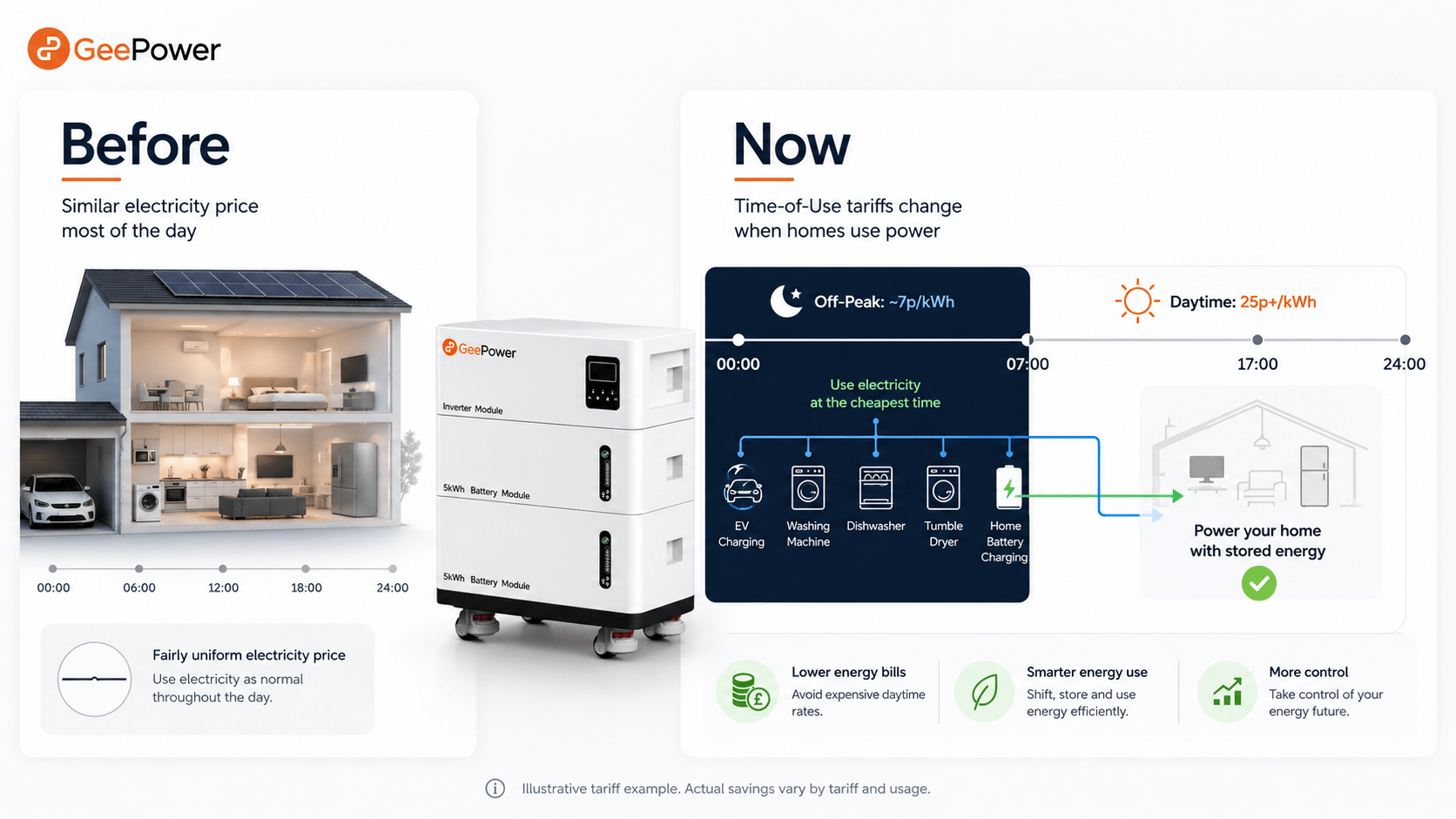
Only a few years ago, most households paid almost the same electricity price throughout the day.
Today, many electricity suppliers offer Time-of-Use (TOU) tariffs, where the price changes depending on the time of day.
For example, many EV owners now benefit from tariffs similar to:
Off-Peak(11:00 pm – 6:00 am):Around 7p/kWh
Daytime: Around 25.4p/kWh
For households without an EV, flexible tariffs can vary even more, with electricity sometimes costing around 18p/kWh during lower-demand periods and reaching 48p/kWh during peak hours.
This pricing model has changed the way many British families use electricity.
Instead of asking "How can we use less electricity?"
More homeowners are asking:
"How can we use electricity at the cheapest time?"
A Typical UK Family
One of our UK partners recently shared something interesting with us.
After switching to an EV tariff, their family began moving almost all high-power appliances into the off-peak period between 11:00 pm and 6:00 am.
Every night, the house automatically schedules:
· EV charging
· Washing machine
· Dishwasher
· Tumble dryer
· Home battery charging
By the time the family wakes up the next morning, the cheapest electricity of the day has already been used to complete most energy-intensive tasks.
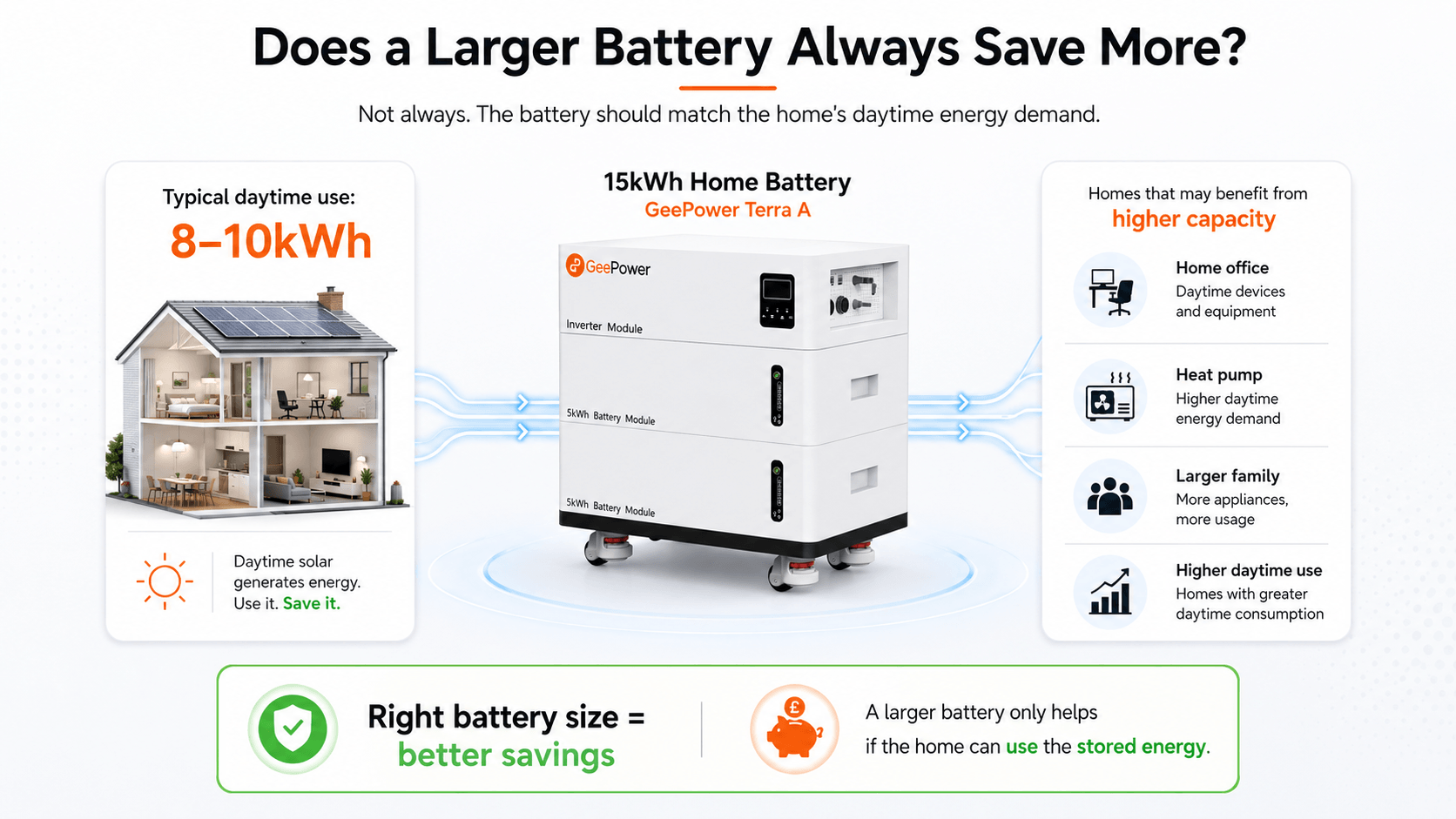
During the daytime, while everyone is at work, the home typically only consumes around 8–10kWh of electricity.
That daytime energy is exactly where a home battery can make the biggest difference.
Where Do The Savings Come From?
Imagine two identical homes.
Both consume exactly the same amount of electricity.
The only difference is when they buy it.
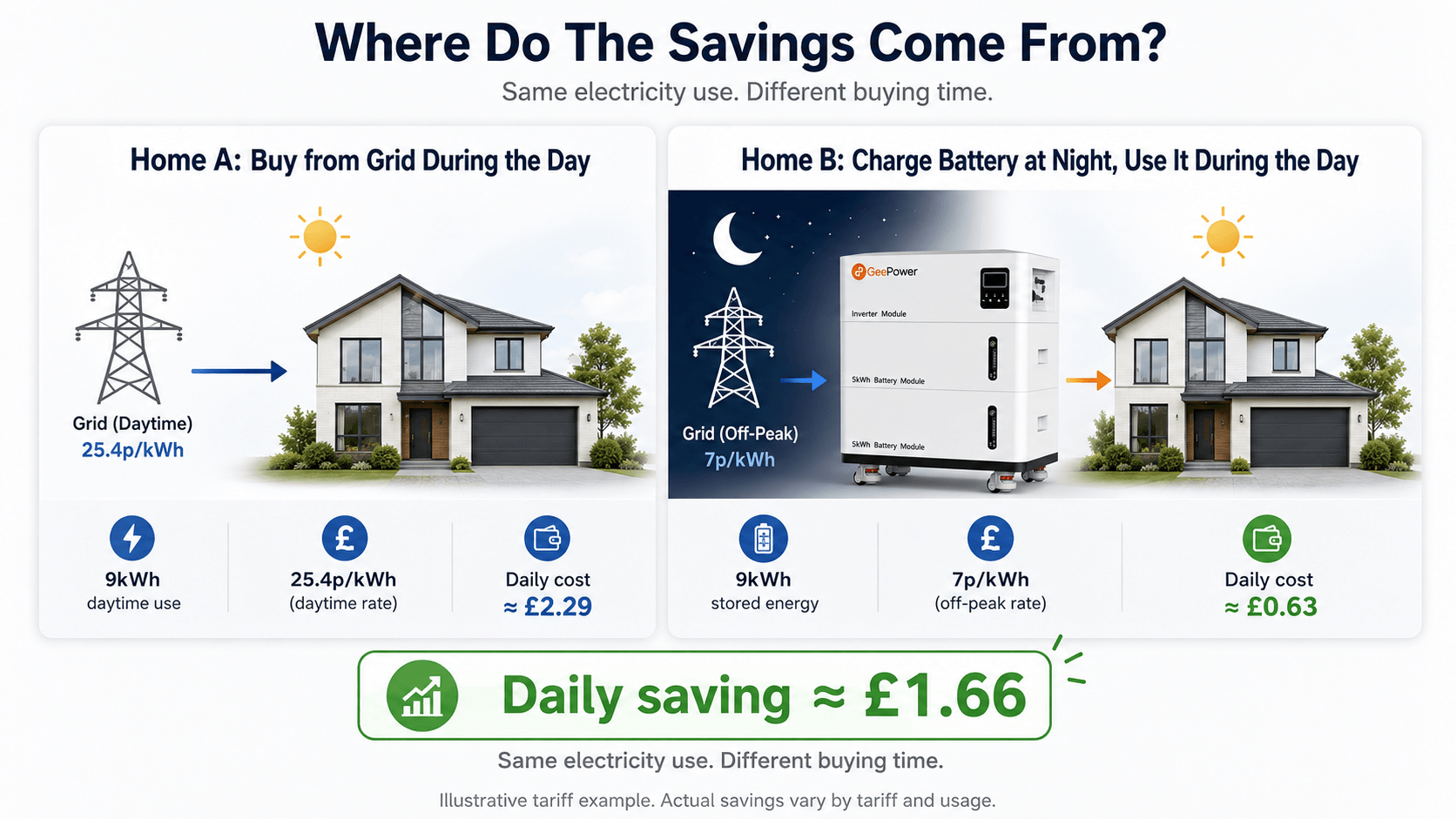
Let's assume both homes require 9kWh of electricity during the daytime.
Home A
Purchases that electricity directly from the grid at 25.4p/kWh.
Daily cost:
≈ £2.29
Home B
Charges a home battery overnight at 7p/kWh, then uses that stored energy during the day.
Daily cost:
≈ £0.63
The household hasn't used less electricity.
It has simply bought electricity at a different time.
That's where the savings come from.
What Could That Mean Over A Year?
If approximately 9kWh of daytime electricity is replaced every day using lower-cost overnight charging:
Daily saving:
Around £1.66
Estimated annual saving:
Around £600 per year under a typical EV tariff. Homes with higher daytime electricity consumption or larger differences between off-peak and peak electricity prices could potentially save £1,000 or more per year
For households using flexible tariffs with a larger price difference between peak and off-peak electricity, the potential savings can be even higher.
The more expensive daytime electricity you replace, the greater the potential return.
Does A Larger Battery Always Save More Money?
Not necessarily.
The goal isn't to install the biggest battery available.
The goal is to install a battery that matches your home's daytime electricity demand.
For many UK homes, daytime consumption is relatively low because most family members are away during working hours.
However, households with:
· Home offices
· Heat pumps
· Larger families
· Higher daytime electricity consumption
may benefit from a larger battery because more low-cost overnight electricity can be stored and used throughout the day.
In other words:
The more expensive daytime electricity you replace, the greater your potential savings.
Installing a larger battery doesn't automatically increase savings. It only increases savings if your household can make use of the additional stored energy.
More Than Just Lower Bills
Financial savings are only one part of the story.
Many homeowners also appreciate the convenience of knowing that:
· Their EV is fully charged every morning.
· The battery is fully charged before the higher-priced daytime period begins.
· Their home automatically makes use of cheaper overnight electricity without changing their daily routine.
There is no need to manually switch between different power sources.
The system quietly manages energy in the background.
A Smarter Way To Buy Electricity
Home batteries are no longer just backup power systems.
In the UK, they are increasingly becoming intelligent energy management systems.
Rather than reducing electricity consumption, they help homeowners buy electricity at the right time.
At GeePower, we believe that is the future of residential energy storage.
Because the smartest way to save money isn't always using less electricity.
Sometimes, it's simply buying it more intelligently.For many UK households, the question is no longer whether electricity is expensive—it's how to buy it more intelligently. A home battery simply makes that possible.