
Partie 2 sur 2. La partie 1 de ce guide traite des pièges du $/kWh, du périmètre du système, de la normalisation de l’énergie et de la comparaison PCS/EMS. Cette partie aborde la conformité, la garantie, les conditions commerciales, l’utilisation de la matrice de comparaison et les signaux d’alerte à vérifier avant de prendre une décision finale.
Il est nécessaire de comparer le périmètre, l’énergie et l’intégration sur une même base. Mais cela ne suffit pas.
Deux devis peuvent sembler comparables côté matériel et pourtant conduire à des résultats de projet très différents — selon la documentation de conformité réellement disponible, la manière dont les réclamations de garantie sont traitées en pratique, l’inclusion ou non de la mise en service dans le prix et l’impact des conditions commerciales sur votre coût rendu réel.
Les étapes 4, 5 et 6 ci-dessous traitent ces écarts. La matrice de comparaison et la liste des signaux d’alerte qui suivent sont conçues pour rendre le processus complet de normalisation gérable entre plusieurs fournisseurs.
Étape 4 : vérifier ce que couvre réellement la conformité indiquée dans le devis
Ne comparez pas les offres en comptant les logos de certification sur une page produit. La bonne question est :
Cette configuration répond-elle aux exigences de conformité de ce marché et de ce projet ?
Un fournisseur peut détenir un certificat pour une configuration de produit donnée. Cela ne couvre pas automatiquement la configuration exacte figurant dans votre offre. Le marché cible ajoute une autre dimension : un système préparé pour un pays peut nécessiter des modifications avant de pouvoir être utilisé dans un autre. Selon le projet, les exigences pertinentes peuvent inclure la documentation de transport des batteries, les normes PCS, la documentation de raccordement au réseau et des éléments de conformité spécifiques au projet — et pas seulement un marquage de conformité du produit.
Posez une question précise plutôt qu’une question générale :
« Quels documents et quelles exigences de conformité s’appliquent au système exact que vous proposez, pour ce projet et sur ce marché ? »
Cela produit une réponse utile. Demander simplement « Avez-vous CE / IEC / UKCA ? » n’en produit généralement pas.
Étape 5 : normaliser la garantie, la mise en service et le support technique
Deux devis avec un matériel et un périmètre normalisé similaires peuvent encore générer des charges de travail très différentes après la livraison.
Garantie. Une « garantie de 5 ans » ne suffit pas comme information. Il faut savoir quelles conditions déclenchent une réclamation recevable, quels seuils de capacité ou de performance s’appliquent, quelles exclusions existent et comment se déroule réellement la procédure de réclamation. Une garantie difficile à faire valoir en pratique vaut moins qu’elle n’en a l’air sur le papier.
Mise en service. Est-elle incluse ou optionnelle ? À distance ou sur site ? Y a-t-il un coût supplémentaire ? Pour de nombreux EPC et intégrateurs, les réponses à ces questions ont davantage d’importance commerciale qu’un faible écart de prix du matériel. Un système moins cher qui oblige l’EPC à gérer seul la mise en service modifie le coût total de livraison.
Support technique. Confirmez ce que le fournisseur prend réellement en charge après l’expédition : configuration du PCS, paramétrage de l’EMS, communication, dépannage, diagnostic à distance. La question n’est pas de savoir quel fournisseur promet le meilleur service, mais si le périmètre du support est défini assez clairement pour que votre équipe projet puisse s’organiser.
Étape 6 : comparer les conditions commerciales sur une même base
Les conditions commerciales peuvent donner l’impression qu’une offre bon marché l’est davantage qu’en réalité. Avant de classer les fournisseurs par prix, ramenez toutes les offres au même périmètre commercial.
Principaux éléments à aligner :
- Incoterm® (EXW, FOB, CIF, DDP)
- Fret et assurance
- Emballage
- Conditions de paiement
- MOQ et quantité du projet
- Délai de livraison
- Disponibilité des pièces de rechange
- Frais de personnalisation
- Frais de mise en service
Une offre EXW de 60 000 USD n’est pas directement comparable à une offre CIF de 65 000 USD. Le second fournisseur couvre peut-être déjà le fret et des services supplémentaires. Ramenez les offres à la même base de livraison avant de tirer des conclusions sur le prix.
Utilisation de la matrice de comparaison
La méthode la plus fiable pour évaluer plusieurs fournisseurs consiste à utiliser un tableau structuré couvrant les mêmes champs pour chaque devis. La matrice organise trois domaines.
Périmètre technique : limite du système, énergie nominale et utilisable, puissance continue, régime en C, marque et modèle du PCS, fonctions de l’EMS, protocoles de communication, type de refroidissement, protection incendie.
Conformité et support : documentation de transport, couverture de conformité du marché, exigences de raccordement au réseau, périmètre de mise en service, conditions de garantie, modalités du support technique, disponibilité des pièces de rechange.
Conditions commerciales : Incoterm®, fret, conditions de paiement, quantité commandée, délai de livraison, périmètre de personnalisation, exclusions.
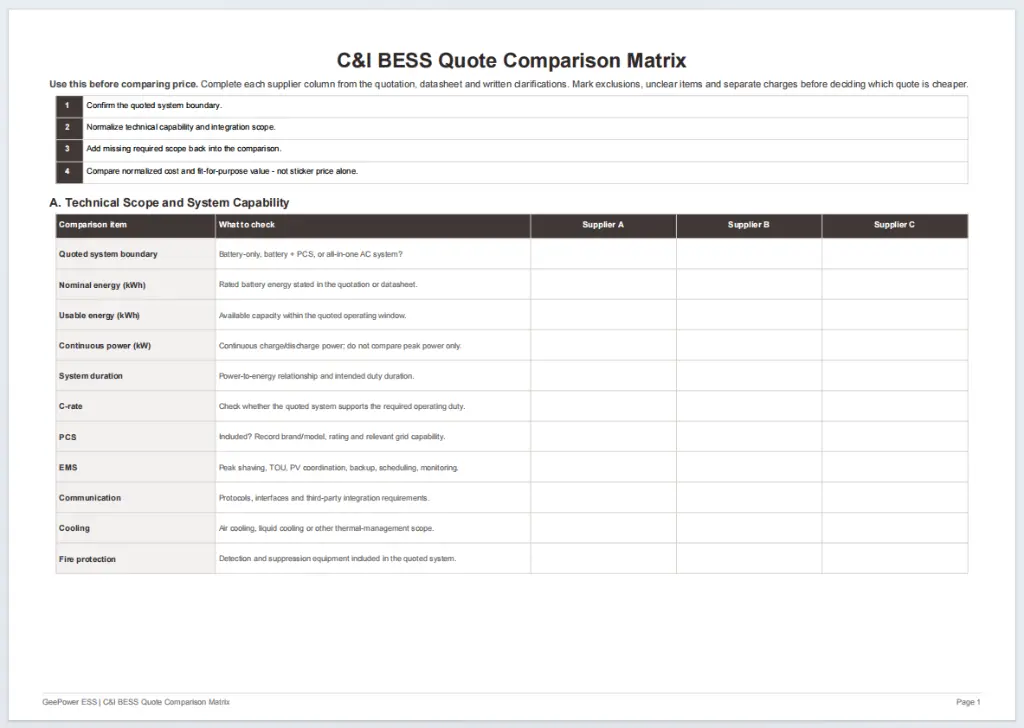
Cinq étapes pour l’utiliser efficacement
Étape 1 : renseignez ce que chaque fournisseur inclut réellement.
Utilisez le devis, la fiche technique et les clarifications écrites — pas des suppositions. Si un point n’est pas clair, indiquez Non spécifié. C’est une information utile en soi et cela signale qu’une question complémentaire est nécessaire avant de terminer la comparaison.
Étape 2 : Identifier les éléments requis manquants dans le périmètre.
Si le fournisseur A exclut le PCS et que le fournisseur B l’inclut, vous ne pouvez pas considérer le fournisseur A comme moins cher sans chiffrer l’écart. Vérifiez si le PCS est nécessaire au projet et ce qu’il ajoute au coût total avant de tirer une conclusion.
Étape 3 : Réintégrer dans le coût les éléments manquants du périmètre.
Appliquez la même logique au fret, à la mise en service, à l’EMS, aux travaux de conformité et à tout autre élément requis. Le chiffre ajusté reflète ce que le projet coûte réellement avec ce fournisseur — et non ce qu’il a choisi d’afficher sur la première page.
Étape 4 : Retirer la valeur des fonctions dont le projet n’a pas besoin.
Le fournisseur C peut inclure des fonctions EMS ou des équipements sans intérêt pour le mode de fonctionnement prévu. Un prix plus élevé n’est pas justifié par davantage d’équipements si le projet ne les utilise pas. Seul le périmètre pertinent pour le projet doit influencer la comparaison finale.
Étape 5 : Comparer le risque projet restant.
Lorsque deux coûts normalisés sont proches, le facteur différenciant devient l’incertitude. La conformité est-elle documentée pour la configuration et le marché précis ? Le périmètre d’intégration est-il clairement défini ? Qui prend en charge la mise en service ? Les conditions de garantie sont-elles suffisamment précises pour être fiables ? Le délai de livraison est-il crédible ?
À ce stade, vous comparez des options d’approvisionnement — pas simplement des prix de produits. C’est le bon niveau pour prendre la décision finale.
Signaux d’alerte avant de choisir le devis le moins cher
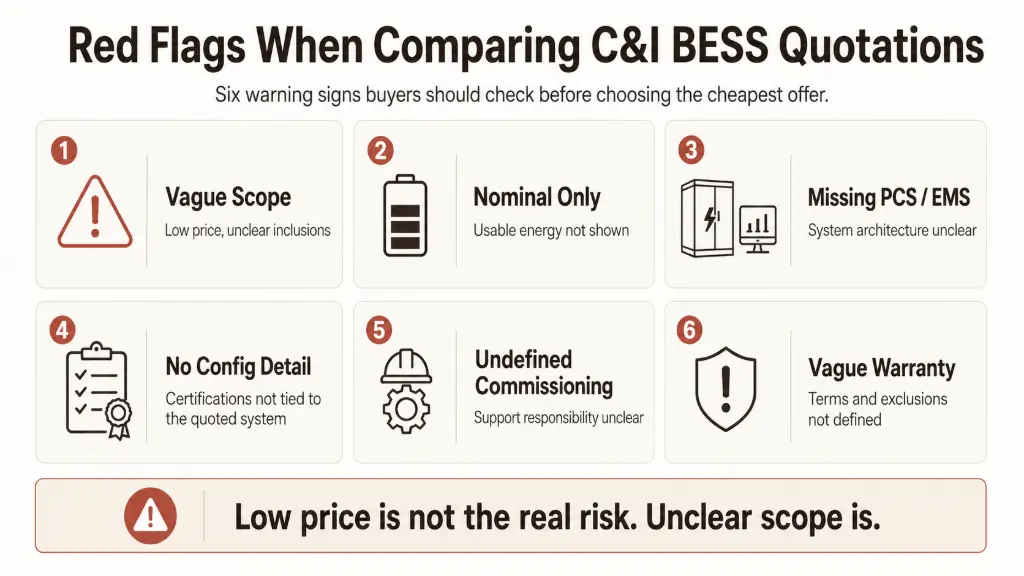
Le prix est nettement inférieur, mais le périmètre est vague.
Un prix bas n’est pas utile si vous ne pouvez pas confirmer ce qu’il inclut. Exigez une limite de système clairement définie avant de considérer l’offre comme réellement comparable.
Seule la capacité nominale est indiquée.
Demandez la capacité utilisable et les hypothèses de plage de fonctionnement du SoC. L’écart entre capacité nominale et capacité utilisable peut être important — et modifier sensiblement la comparaison en $/kWh.
Les informations sur le PCS ou l’EMS sont absentes.
Une offre « ESS complet » doit définir l’architecture du système. Une réponse évasive à une question directe constitue en elle-même un signal à prendre en compte.
Les certifications sont indiquées sans préciser les configurations concernées.
Un certificat délivré pour une configuration de produit ne s’applique pas automatiquement à une autre configuration ni à un autre marché cible. Confirmez la couverture pour le système exact faisant l’objet de l’offre.
La responsabilité de la mise en service n’est pas définie.
Clarifiez ce que le fournisseur prend en charge et ce que l’EPC doit couvrir de manière indépendante. Si ce point n’est pas résolu au stade de l’offre, il devient ensuite un problème de gestion de projet.
Les conditions de garantie sont vagues.
Une « garantie de cinq ans » doit être assortie de conditions, de seuils de performance et d’une procédure de réclamation. Si ces éléments ne sont pas disponibles dès le départ, la couverture peut ne pas tenir les promesses qu’elle semble offrir.
Décision finale : la valeur adaptée à l’usage, pas le prix affiché
Le devis le moins cher peut être le bon choix. Mais seulement après avoir confirmé qu’il est réellement comparable.
La séquence de décision :
Prix indiqué → coût comparable normalisé → valeur d’adéquation à l’usage
La question finale ne devrait pas être : quel fournisseur m’a proposé le prix le plus bas ?
Il doit être :
Quelle offre fournit le périmètre technique, de conformité et de support requis pour ce projet — avec le moins de coûts inutiles et un niveau de risque acceptable ?
C’est une base plus fiable pour choisir un fournisseur de BESS C&I.
FAQ
EXW, FOB, CIF et DDP attribuent différentes responsabilités et différents coûts logistiques à l’acheteur et au vendeur. Un prix EXW exclut le fret, l’assurance et les formalités d’exportation. Un prix CIF couvre le fret et l’assurance jusqu’au port désigné. Les comparer directement sans ajustement crée un écart de coût trompeur. Ramenez toutes les offres à la même base Incoterms® — ou, au minimum, ajoutez une estimation du fret aux offres EXW — avant de les classer par prix.
Pas automatiquement. Une fois le périmètre technique rendu comparable, il faut encore évaluer le risque d’intégration, le niveau de préparation à la conformité, la clarté de la mise en service, les conditions de garantie, le délai de livraison et les capacités de support technique. Deux devis ayant des coûts normalisés proches peuvent présenter des niveaux de risque projet très différents.
Lorsqu’il comprend un élément dont le projet a réellement besoin : davantage d’énergie utilisable, la capacité PCS requise, des fonctions EMS adaptées au mode de fonctionnement, une conformité confirmée pour le marché cible, un support de mise en service ou une couverture de garantie clairement définie. Un prix plus élevé ne vaut pas la peine pour des fonctions inutilisées, un équipement surdimensionné ou une prime de marque qui n’apporte rien à ce projet précis.
L’exclusion du PCS est l’omission la plus fréquente — notamment lorsque des devis d’armoires batterie seules sont comparés directement à des systèmes AC tout-en-un. Le périmètre de mise en service et la documentation de conformité sont les omissions suivantes les plus courantes. Ces écarts n’apparaissent généralement ni dans le prix affiché ni dans la fiche technique, ce qui explique précisément pourquoi le processus de normalisation présenté dans les parties 1 et 2 de ce guide est nécessaire.
Matrice de comparaison des offres BESS C&I
Comparez jusqu’à trois offres fournisseurs sur le périmètre technique, le PCS/EMS, la conformité, la mise en service, la garantie et les conditions commerciales.
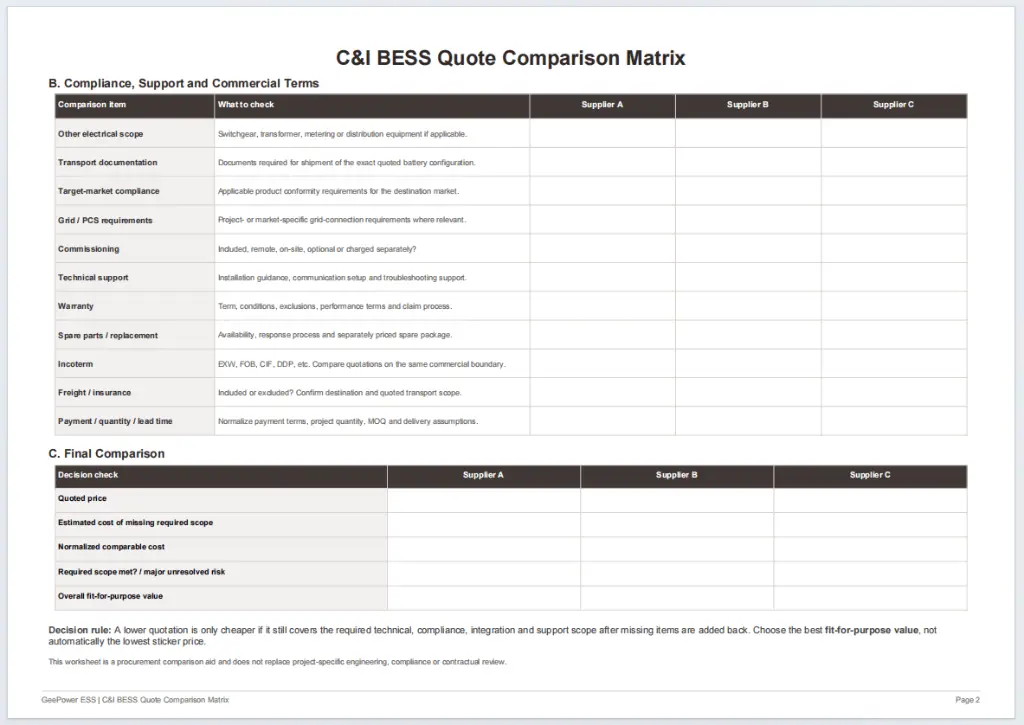
→ [Télécharger la matrice de comparaison des devis BESS C&I]
PDF · 2 pages · Aucune inscription requise
Vous comparez des offres BESS C&I pour un projet concret ?
Définissez la référence technique avant de comparer les prix. Indiquez la puissance requise, la capacité de stockage, le mode de fonctionnement, le lieu du projet et les principales exigences du système.
GeePower peut vous aider à examiner la configuration et à clarifier le périmètre du système avant de commencer la comparaison des devis.
→ [Contacter GeePower pour l’examen d’un projet C&I]
→ [Voir les produits BESS C&I GeePower]