
Partie 1 sur 2. Cet article explique pourquoi les comparaisons en $/kWh peuvent être trompeuses, comment confirmer le périmètre du système et comment normaliser l’énergie, la puissance et le niveau d’intégration avant de comparer les prix. La partie 2 traite de la conformité, des conditions commerciales et de la matrice de comparaison complète.
Vous demandez à trois fournisseurs de chiffrer le même système :
BESS C&I 100 kW / 215 kWh.
Les devis reviennent avec un écart de prix significatif. Le fournisseur A est le moins cher. Le fournisseur B est 12 % plus cher. Le fournisseur C coûte encore davantage.
Quelle est la meilleure offre ?
Vous ne pouvez pas le savoir à partir du prix total. Pas encore.
Deux devis peuvent afficher exactement les mêmes valeurs en kW et kWh sur la première page tout en comprenant du matériel, des fonctions de contrôle, un périmètre de conformité et des conditions commerciales complètement différents. Comparer directement ces chiffres ne vous dit pas quel fournisseur est le moins cher. Cela vous dit seulement lequel a indiqué le prix le plus bas — ce qui n’est pas la même chose.
Ce guide couvre les devis des fabricants et fournisseurs. Il ne cherche pas à calculer le coût installé total d’un projet de stockage d’énergie C&I. L’objectif est plus simple :
Placez les offres de différents fournisseurs sur une base comparable. Décidez ensuite si l’écart de prix est justifié.
Pourquoi le $/kWh seul peut être trompeur
Le $/kWh est un raccourci utile, mais seulement lorsque les systèmes comparés sont réellement similaires.
Imaginez deux offres toutes deux intitulées BESS C&I 100 kW / 215 kWh. Le fournisseur A propose une armoire batterie, un BMS et une surveillance de base. Le fournisseur B inclut un système de batteries, un PCS de 100 kW, un EMS, le CVC, l’extinction incendie et la mise en service à distance. Même intitulé en couverture. Périmètre commercial totalement différent en dessous.
Les chiffres de capacité posent le même problème. Un fournisseur indique la capacité nominale, un autre la capacité utilisable. La puissance nominale du PCS, le régime en C, les fonctions EMS, la conception du refroidissement, les interfaces de communication, les conditions de garantie et les conditions d’expédition peuvent tous varier entre des offres qui paraissent identiques au premier regard.
La première règle pour comparer des devis BESS C&I :
Ne comparez pas le $/kWh tant que vous ne savez pas exactement ce que chaque fournisseur inclut dans son offre.
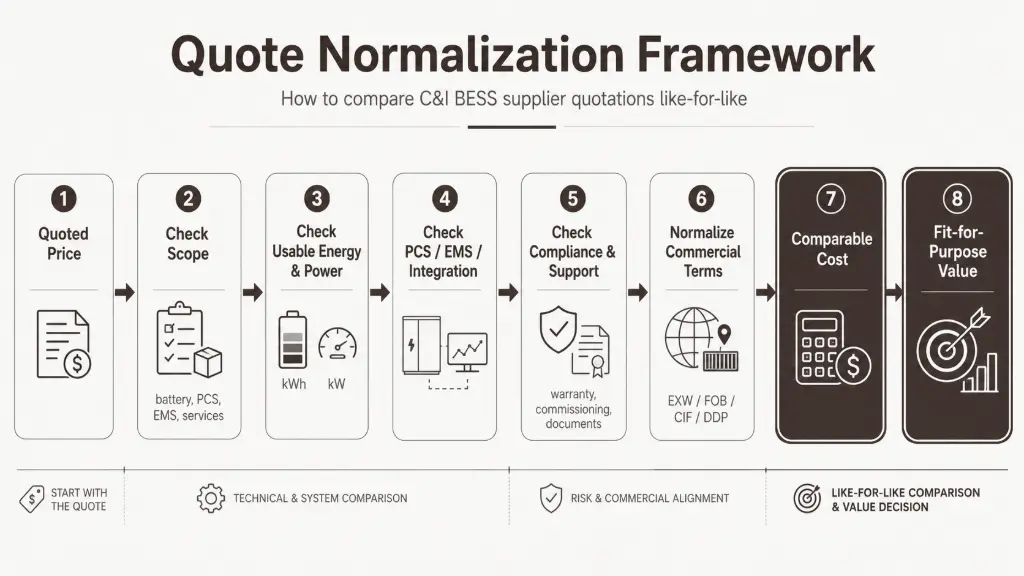
Étape 1 : confirmer ce qui est réellement inclus dans le devis
Avant toute chose, posez la même question à chaque fournisseur : qu’est-ce que ce prix inclut exactement ?
Puis examinez la réponse composant par composant.
Périmètre batterie. Confirmez que les modules de batterie, les racks et le BMS sont tous inclus. Surtout, distinguez la capacité nominale de la capacité utilisable. Deux systèmes de 215 kWh peuvent fournir des quantités d’énergie sensiblement différentes en pratique. Ne supposez pas qu’ils sont équivalents.
Périmètre PCS. Le PCS est-il inclus ? Si oui, quelle marque, quel modèle et quelle puissance nominale ? Une armoire AC intégrée constitue une offre fondamentalement différente d’une armoire batterie seule, quel que soit le nombre de kWh affiché en couverture.
Périmètre EMS. « EMS inclus » ne dit presque rien. Demandez ce que le système peut réellement faire. Les fonctions pertinentes dépendent du projet :
- Écrêtage des pics de consommation
- Déplacement de consommation selon les plages horaires
- Coordination photovoltaïque
- Charge et décharge programmées
- Fonctionnement en secours
- Surveillance à distance
Un fournisseur qui ne peut pas préciser ces éléments ne fait que supposer si le système convient à votre projet.
Systèmes auxiliaires. Le type de refroidissement, le CVC, la détection et l’extinction incendie doivent tous faire partie de la discussion sur le périmètre. Ils influencent le coût du système, les exigences d’installation et la maintenance à long terme — et sont faciles à oublier lorsque les chiffres principaux semblent corrects.
Périmètre électrique. Confirmez si l’appareillage de commutation et de protection, le comptage, les équipements de distribution ou les éléments liés au transformateur sont inclus. Si un fournisseur couvre davantage de ces éléments, son prix plus élevé peut déjà refléter un coût total inférieur.
Étape 2 : normaliser l’énergie et la puissance
Une fois le périmètre clarifié, la question change. Ce n’est plus « combien de kWh possède-t-il ? », mais que peut réellement fournir le système ?
Énergie nominale vs utilisable. Une offre indique 215 kWh nominaux. Mais la plupart des systèmes fonctionnent dans une plage de SoC définie, de sorte que l’énergie disponible est inférieure à la valeur nominale. Comparez, pour chaque offre, l’énergie nominale, l’énergie utilisable, la profondeur de décharge (DoD) recommandée et la plage de fonctionnement du SoC. Si un fournisseur indique la capacité nominale et un autre la capacité utilisable, leurs chiffres en $/kWh ne sont pas comparables — même s’ils semblent proches.
Puissance continue. Une batterie de 200 kWh associée à un PCS de 50 kW correspond approximativement à un système de quatre heures à puissance nominale. Avec un PCS de 100 kW, elle devient un système de deux heures. La capacité de batterie est identique, mais pas la capacité d’application. Confirmez la puissance continue de charge et de décharge, la puissance nominale du PCS et, le cas échéant, la puissance de pointe.
Régime en C. Un rapport puissance/énergie plus élevé exige généralement un choix différent de cellules, une gestion thermique différente, une capacité PCS adaptée et une architecture système spécifique — autant d’éléments qui influencent le coût. La question n’est pas de savoir si un régime en C plus élevé est intrinsèquement meilleur, mais si le régime en C proposé correspond au profil d’utilisation réel du projet.
Comparez d’abord les capacités système requises. Comparez le prix ensuite.
Étape 3 : comparer le périmètre du PCS, de l’EMS et de l’intégration
Cette étape est particulièrement importante pour les EPC et les intégrateurs système. Un BESS moins cher peut générer nettement plus de travail d’ingénierie après la livraison — et ce coût n’apparaît pas dans le devis.
PCS. Ne considérez pas tous les PCS de 100 kW comme équivalents. Comparez la marque, le modèle, les caractéristiques réseau, les modes de fonctionnement et l’interface entre le PCS, la batterie et l’EMS. Les problèmes d’intégration qui apparaissent pendant la mise en service sont coûteux à résoudre.
EMS. Adaptez le périmètre de l’EMS aux besoins réels du projet. Une application d’écrêtage des pics de consommation nécessite la surveillance des charges, la programmation de la charge/décharge et le contrôle des limites de puissance. Un projet PV + stockage nécessite le contrôle de l’injection, une logique d’autoconsommation et la coordination avec les plages tarifaires. Davantage de fonctions ne signifie pas une meilleure valeur si le projet ne les utilise pas : elles ne font qu’augmenter le coût.
Communication. Les protocoles pris en charge, les interfaces et la compatibilité avec les appareils tiers sont faciles à négliger lors de l’examen d’une offre. Ils deviennent souvent importants pendant la mise en service. Un prix matériel plus bas perd rapidement son avantage si l’EPC doit absorber un temps d’intégration non prévu au budget.
Trois chiffres indispensables à toute comparaison d’achats
Après avoir cartographié le périmètre, l’énergie et l’intégration, trois chiffres distincts apparaissent.
Le prix indiqué est celui qui figure sur le document du fournisseur. C’est un point de départ utile, mais pas une base de comparaison fiable à lui seul.
Le coût comparable normalisé est obtenu après réintégration des éléments requis qu’une offre exclut. Si le fournisseur A exclut le PCS, le fret et la mise en service — alors que ces trois éléments sont requis pour le projet — estimez leur coût supplémentaire et ajoutez-le. L’objectif n’est pas d’obtenir une précision au dernier dollar. Il s’agit d’éviter de comparer directement une offre à périmètre complet avec une offre incomplète.
La valeur d’adéquation à l’usage constitue le filtre final. Le coût normalisé indique quelle offre est moins chère à périmètre identique. Il ne dit pas laquelle répond réellement au projet. Le système doit toujours satisfaire aux exigences de puissance, d’énergie, de conformité, d’intégration et de support.
Offre la moins chère ≠ coût comparable le plus bas ≠ meilleure valeur
FAQ
La capacité nominale correspond à l’énergie totale que les cellules peuvent stocker. La capacité utilisable est celle disponible dans la plage de fonctionnement du SoC — elle est toujours inférieure à la capacité nominale. Un fournisseur qui indique la capacité nominale peut sembler proposer davantage de kWh qu’un autre qui indique la capacité utilisable, alors que l’énergie réellement disponible est identique ou inférieure. Demandez les deux valeurs ainsi que les hypothèses de profondeur de décharge (DoD) avant toute comparaison.
Oui — mais seulement après avoir normalisé les devis sur le même périmètre. Si un fournisseur inclut le PCS, l’EMS, le CVC et la protection incendie tandis qu’un autre ne chiffre que l’armoire batterie, diviser les deux montants par les kWh produit des chiffres qui ne sont pas réellement comparables. Normalisez d’abord le périmètre. Utilisez ensuite le $/kWh comme contrôle de cohérence, pas comme outil de classement.
Parce que les kW et les kWh ne décrivent qu’une partie du système. Le prix dépend également de la chimie et de la qualité des cellules, de la marque et du modèle du PCS, des capacités de l’EMS, de la conception du refroidissement, du type de protection incendie, de la préparation à la conformité, des conditions de mise en service et de la structure de garantie. Deux systèmes présentant les mêmes caractéristiques principales peuvent correspondre à des offres commerciales très différentes.
Au minimum : limites du système et périmètre matériel, énergie nominale et utilisable, puissance nominale et marque du PCS, fonctions de l’EMS, type de refroidissement, protection incendie, couverture de conformité, conditions de mise en service, conditions de garantie, Incoterm® et exclusions. Tout élément non précisé doit être signalé et confirmé avant de comparer les prix.
Oui — et c’est souvent là que commence le problème de comparaison. Si les fournisseurs reçoivent des exigences différentes ou vagues, leurs devis reposent sur des hypothèses différentes. Aucune normalisation a posteriori ne corrige complètement cela. Envoyez à chaque fournisseur le même cahier des charges : puissance et énergie requises, mode de fonctionnement, profil de charge, informations PV, conditions du réseau, besoins de secours, localisation du projet, exigences de conformité et conditions de livraison.
La partie 2 de ce guide traite du périmètre de conformité, des conditions de garantie, des conditions commerciales, de l’utilisation d’une matrice de comparaison structurée — ainsi que des signaux d’alerte indiquant qu’une offre n’est pas ce qu’elle semble être.
→ [Continuer vers la partie 2 : Comment comparer les devis BESS C&I sur une base équivalente →]
Vous comparez des fournisseurs de BESS C&I pour un projet concret ? GeePower peut vous aider à examiner les exigences de configuration et à clarifier le périmètre du système avant de commencer à comparer les offres.
→ [Contacter GeePower pour l’examen d’un projet C&I]
→ [Voir les produits BESS C&I GeePower]