
A standard 20ft container is 6.058 m long. A standard 40ft container is 12.192 m long. Those dimensions let you draw the first rectangle on a site plan. To decide how many rectangles to draw, you need to specify the power the battery must deliver and how long it must sustain that output.
Consider a factory that needs 2,400 kWh during its peak period. As the worked example below shows, a single 40ft system can make the shortlist for a six-hour discharge and drop off it when the same energy is needed in three hours. That is why, when we look at an enquiry, we start from kW and hours rather than from the container.
What are the dimensions of a 20ft or 40ft BESS container?
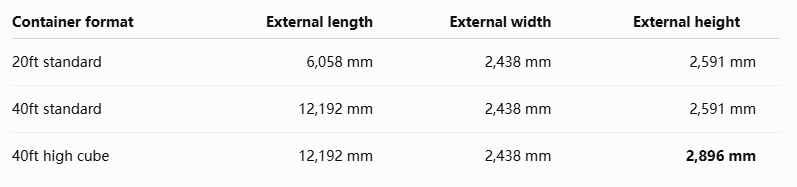
These are reference dimensions for freight containers, taken from EKB's container dimension tables. A 40ft high cube has the same base as the standard version and an extra 305 mm of height. For a particular BESS, use the supplier’s drawing to check the overall dimensions with external fittings installed. Ask for the shipping dimensions separately if any fittings travel detached. Treat datasheet figures as a first screen; the supplier’s drawings and written confirmation settle the rest.
Match container capacity and power to the job
Give every supplier the same discharge requirement. Specify continuous AC power in kW, usable energy in kWh and where you will measure delivery. A figure measured at the inverter terminals can differ from what reaches the factory meter after auxiliary consumption and downstream losses. If the requirement is a constant load, multiply kW by hours to get the energy needed at that meter.
Now compare those figures with actual models. These three GeePower systems all list 500 kW rated AC output.
| GeePower model | Container and external dimensions as listed | Nominal battery energy | Rated AC output | Datasheet weight |
|---|---|---|---|---|
| GP-ESS1000-716.8V1400Ah | 20ft · 6,058 × 2,438 × 2,591 mm | 1,003.52 kWh | 500 kW | 16.5 t |
| GP-ESS1500-768V1960Ah | 20ft · 6,058 × 2,438 × 2,591 mm | 1,505.28 kWh | 500 kW | 21 t |
| GP-ESS5000-716.8V7000Ah | 40ft · exact dimensions not specified | 5,017.6 kWh | 500 kW | Not specified |
The second 20ft unit carries 501.76 kWh more nominal energy than the first and weighs 4.5 tonnes more. Moving up to the listed 40ft unit takes nominal battery energy to 5,017.6 kWh, while rated output stays at 500 kW. The datasheet lists only a plain weight, so get the weight in the agreed shipping configuration before booking transport. GeePower container BESS specifications
If the project is still deciding between cabinets and containers, settle that question before comparing box sizes; our cabinet vs container selection guide is the place to start. If backup is the duty and the required kW or kWh is still unknown, start with the critical loads and their required runtime, as in our worked example for two-hour commercial backup.
What is inside the container, and what does the site have to supply?
Open the equipment list alongside the layout; it is the first thing we check in any offer. In GeePower’s 1 MWh reference design, the battery racks and the power conversion system (PCS) occupy different parts of the same container. The drawing also shows where the DC combiner cabinet sits, along with the air conditioning and fire protection. The supply list in the 1 MWh user manual gives one example. The project package lists three storage containers, one grid-connection cabinet and one load cabinet as separate items. Counting only the containers would leave two cabinets unaccounted for on the project equipment list.
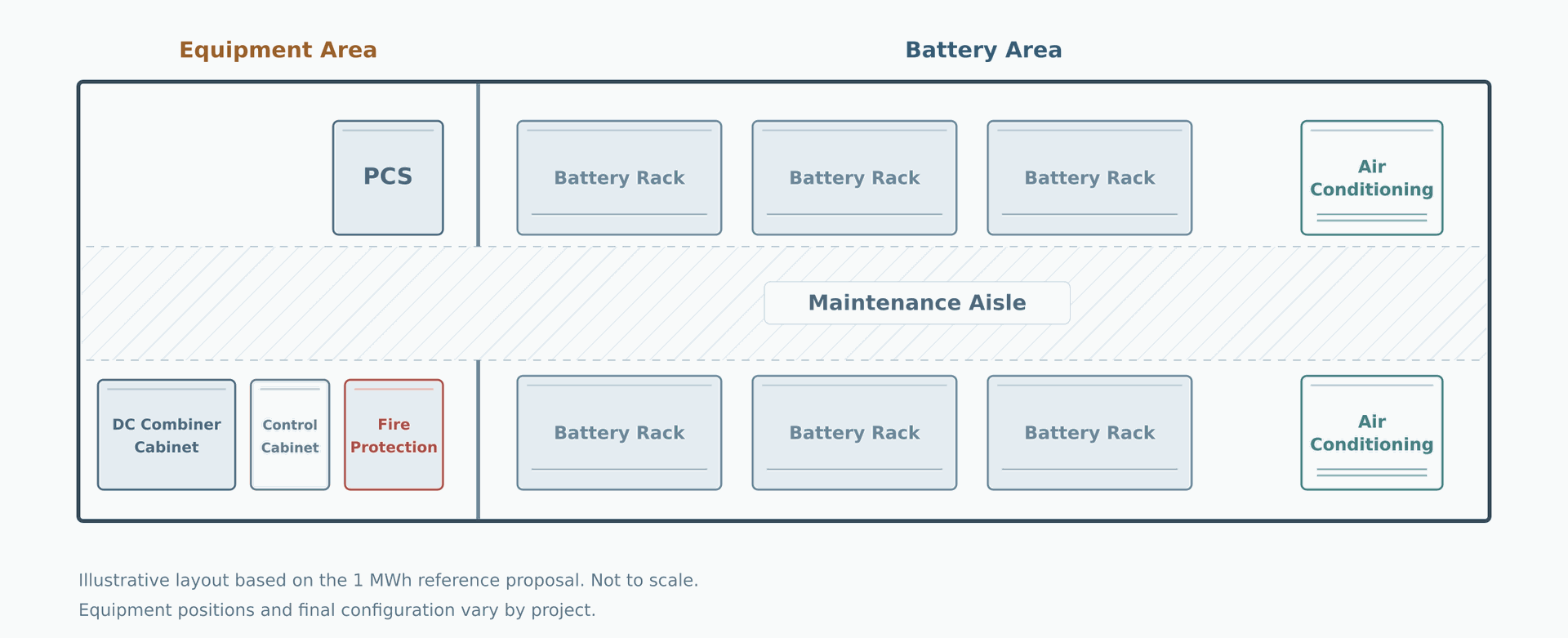
GeePower 1 MWh reference layout. Use this view to locate equipment. Its length annotation differs from the model datasheet. For the site plan, use the general arrangement (GA) drawing issued for the quoted unit. Container layout and system architecture
Ask each bidder to mark the PCS, transformer and switchgear as inside the container, supplied separately, provided by the site or to confirm. If an offer covers a DC battery enclosure, identify the PCS required to meet the AC duty and add its location to the drawing. All three GeePower datasheets above list a built-in isolation transformer. If the connection requires a step-up transformer and medium-voltage switchgear, who supplies them and where they will stand are both worth settling early.
One 40ft or two 20ft containers? A worked industrial comparison
Illustrative project. Suppose your grid-connected factory needs its BESS to deliver a net 400 kW for six hours at an agreed AC meter when the system enters service. That is 2,400 kWh per discharge. Both bids must use the same starting and ending state of charge. You credit only battery discharge towards the target, so solar generation during those six hours cannot make up a shortfall.
Start with one 20ft unit. Either model has sufficient rated power for a 400 kW first check. Even the larger one stores only 1,505.28 kWh nominally, so a single unit cannot cover this discharge. That leaves three configurations worth putting on paper.
| Candidate | What the ratings establish | Shortlist decision |
|---|---|---|
| Two 20ft units, 1,003.52 kWh each | 2,007.04 kWh nominal in total. Even before losses, the pair falls 392.96 kWh short. | Rule out. No layout work is needed for this pair under the stated duty. |
| Two 20ft units, 1,505.28 kWh each | 3,010.56 kWh nominal. The two 500 kW unit ratings sum to 1,000 kW. | Keep for review. Get the net six-hour delivery figure, plus the supplier’s proposed controls, protection and shared AC equipment for parallel operation. |
| One 40ft unit, 5,017.6 kWh | 5,017.6 kWh nominal and 500 kW rated output. Both figures clear the first check. | Keep for review. Get the same net delivery figure, the AC equipment list, and the dimensions and shipping weight for this model. |
Put the same question to both remaining bidders. How many net kWh will this configuration deliver at our meter while holding 400 kW for the full six hours? Ask the supplier to state the conditions behind its answer: the usable state-of-charge window and temperature first, then conversion losses and auxiliary loads. This example specifies performance at commissioning. If you need the same duty later in the battery’s life, specify that year in both enquiries.
Now shorten the discharge window to three hours and keep the 2,400 kWh target. You need 800 kW. The listed 500 kW single 40ft unit drops out on power, regardless of its remaining battery energy. The pair of larger 20ft units stays under review until the supplier confirms output at the common meter. This is why we ask for the hours before we talk about the number of containers. The same energy-versus-power distinction matters for future expansion: a longer discharge calls for more usable kWh, while a higher peak also calls for a check on the PCS, site distribution and connection capacity.
How much site space do the shortlisted options need?
Two reference 20ft bases cover about 29.5 m² in total (2 × 6.058 × 2.438 m). One standard 40ft base covers about 29.7 m² (12.192 × 2.438 m), using standard container dimensions; the exact outline of the quoted 40ft BESS still needs its own drawing. The two footprints are nearly the same, so floor area alone will not decide this.
Send both suppliers the same site sketch with the available area, electrical connection point and delivery entrance marked. Ask for these details on each proposed layout:
| On the site sketch | One 40ft unit | Two 20ft units |
|---|---|---|
| Equipment outside the box | Locate any separate conversion, transformer or switchgear equipment and the cable entry. | Identify which cabinets the two units share, which each unit needs, and where the cables meet. |
| Access after installation | Mark door swing, service sides and the route for removing equipment. | Mark the same features on both containers. Check whether an open door or removal route on one blocks access to the other. |
| Delivery and placement | Check the route and lifting position against the actual shipping dimensions and weight. | Check each lift, including whether the first container in position leaves access for the second. |
The supplier provides the equipment GA and shipping data. The local EPC can then check the drawings against the surveyed site, including fire-service access and maintenance clearances, as well as the delivery route. If one arrangement fits only by putting separate switchgear in space the owner needs for access, that is a reason to revise or drop it. Comparing square metres alone would miss it.
How an Estonian factory split 3 MWh across three containers
Here is a real configuration to set against your own: battery energy is counted in containers, and inverter rating is counted separately. At a heat-pump factory in Estonia, GeePower’s project record lists three 1 MWh containerized storage units and three 500 kW hybrid inverter systems, alongside a 2 MWp solar PV array. The plant therefore has 3 MWh of listed battery capacity and 1.5 MW of aggregate inverter rating (the 2 MWp belongs to the solar array).
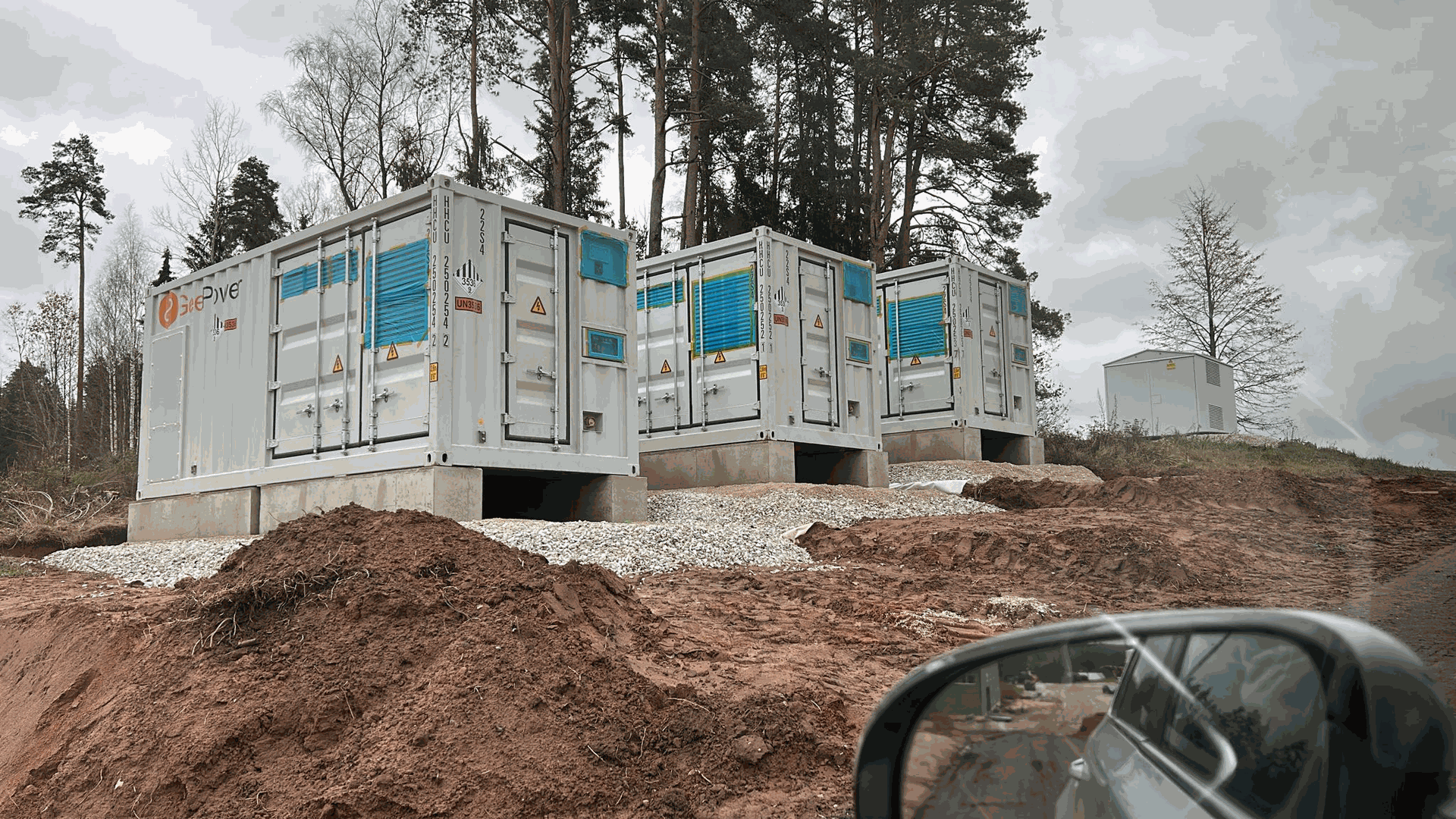
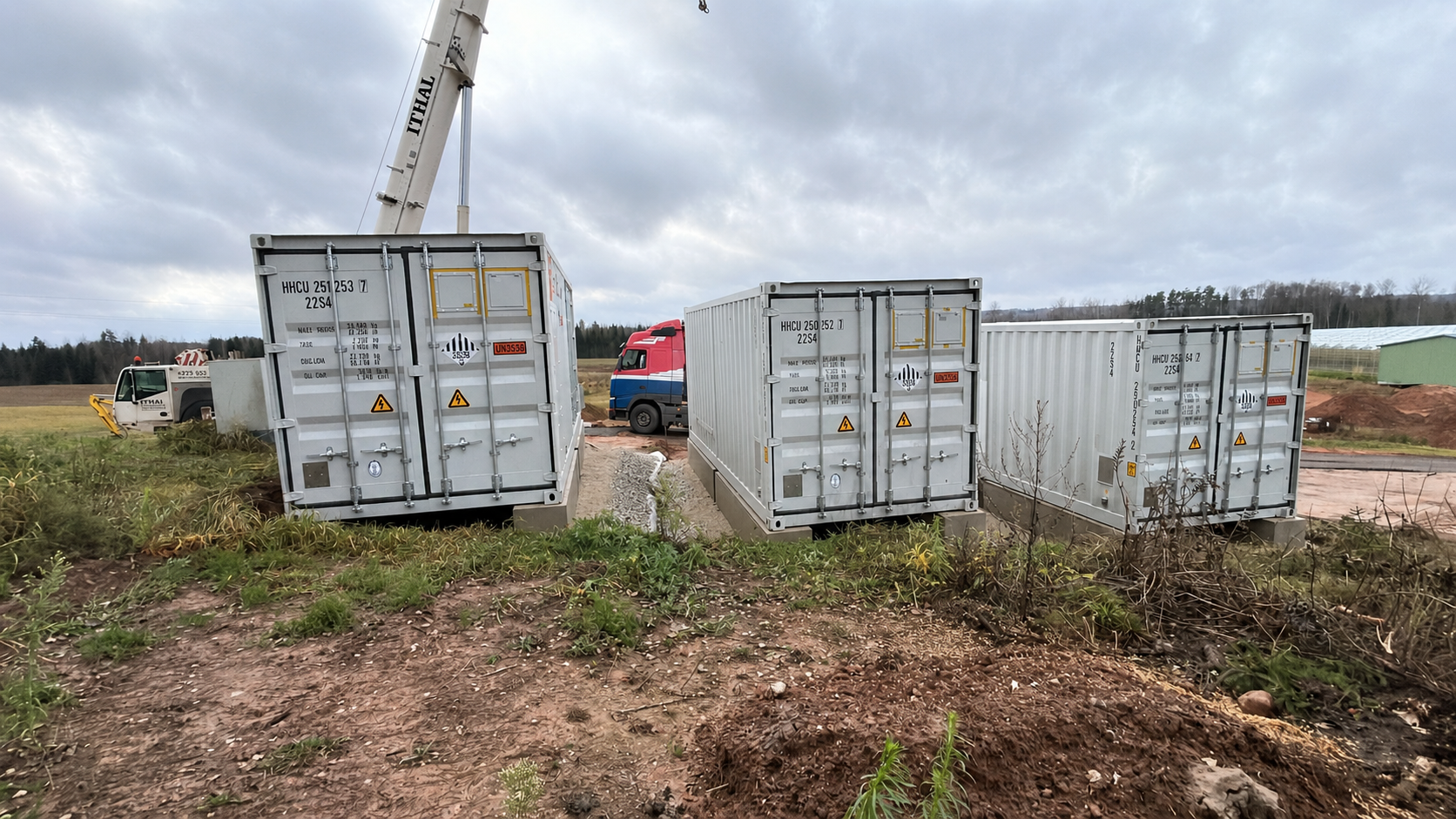
For an enquiry of your own, ask each supplier to list the battery energy per container, the number of containers, and the number and rating of the inverters. To establish how long your site can draw a given load, request the net discharge figure at your own metering point.
What to send for a container configuration review
Copy the table below into your enquiry and replace the factory example with your own figures. The candidate columns show what you can fill in from the datasheets and what the supplier or local EPC still needs to confirm.
| Project requirement | A · Two 20ft units | B · One 40ft unit | Decision so far | Evidence needed / who provides it |
|---|---|---|---|---|
| 400 kW continuous at the factory AC meter | 2 × 500 kW rated | 500 kW rated | Keep both for now | Supplier confirms continuous net AC output. |
| 2,400 kWh at that meter over 6 h, at commissioning | 3,010.56 kWh nominal | 5,017.6 kWh nominal | Waiting on the supplier’s net kWh | Supplier gives net kWh under the agreed operating conditions. |
| Container count and equipment scope | 2 boxes with shared AC equipment to identify | 1 box with external equipment to identify | Waiting on the equipment list | Supplier marks each item as internal, separately supplied or site-provided. |
| Installed layout | GA for both boxes and shared equipment | GA with exact unit dimensions | Waiting on layouts | Owner supplies site sketch. Supplier returns layouts for local EPC review. |
| Delivery route and weight | Datasheet lists 21 t per unit | Weight not specified | Waiting on shipping weight | Supplier confirms as-shipped size and weight. EPC and haulier check the route. |
Include the project location, grid connection voltage and any existing transformer or switchgear you intend to reuse. If a detail is unknown, enter To confirm and name the person who can resolve it. For projects still gathering those inputs, use the C&I project requirements checklist.
Discuss your BESS project
If you would like us to look at your shortlist, paste the duty and open items into the contact form’s Additional Message field and mention any site sketch available for review.
Frequently Asked Questions About BESS Container Size
Capacity varies by model. Two GeePower 20ft configurations have the same published dimensions and the same 500 kW rated output, but one stores 1,003.52 kWh and the other stores 1,505.28 kWh of nominal battery energy. For a project enquiry, ask how many usable kWh the system can deliver at your AC meter over the required discharge period.
Two 20ft units are a candidate when they can operate together and meet the same continuous AC power and usable energy requirements at the agreed meter. Ask the supplier to confirm parallel operation, shared switchgear and protection, then compare both site layouts. Two standard 20ft boxes occupy about 29.5 m² at their bases, close to the 29.7 m² of one standard 40ft box. External equipment and service access can change how much land each arrangement needs.
Yes, in principle. If the site needs the same kW for longer, the extra requirement is usable energy. Ask the supplier whether the proposed battery expansion is compatible with the existing power conversion system (PCS) and controls. If the site needs the same kWh in a shorter window, check power again. Delivering 2,400 kWh in six hours requires 400 kW; delivering it in three hours requires 800 kW.