
One of the first questions UK homeowners ask when comparing home battery systems is simple:
“How big should my battery be?”
The answer is not always:
“Choose the largest one.”
A home battery should be sized around how your household actually uses electricity.
If the battery is too small, it may run out before the higher-priced daytime period ends.
If the battery is too large, part of the stored energy may sit unused, which means the extra capacity may not improve your savings.
The right battery size depends on your home’s energy demand, solar generation, Time-of-Use tariff, backup needs and future plans.
In simple terms:
The best battery is not always the biggest battery.
It is the battery that matches your home.
Why Battery Size Matters
A home battery stores electricity for later use.
But the value of that storage depends on whether the home can actually use the energy inside the battery.
For many UK households, battery storage is mainly used in two ways:
· Store cheaper off-peak electricity at night and use it during the day.
· Store excess solar energy and use it later when solar generation drops.
In both cases, the battery needs to match the home’s real energy pattern.
A household that only uses 5–6kWh during the daytime may not need a very large battery.
A household with a home office, heat pump, EV charging pattern or higher daytime consumption may benefit from a larger system.
That is why battery sizing should start with one question:
How much electricity does your home need when the battery is expected to supply it?
Step 1: Look at Daytime Electricity Demand
Many homeowners first look at their total daily electricity consumption.
But for battery sizing, that is not always the most useful number.
The more important question is:
How much electricity do you want the battery to cover?
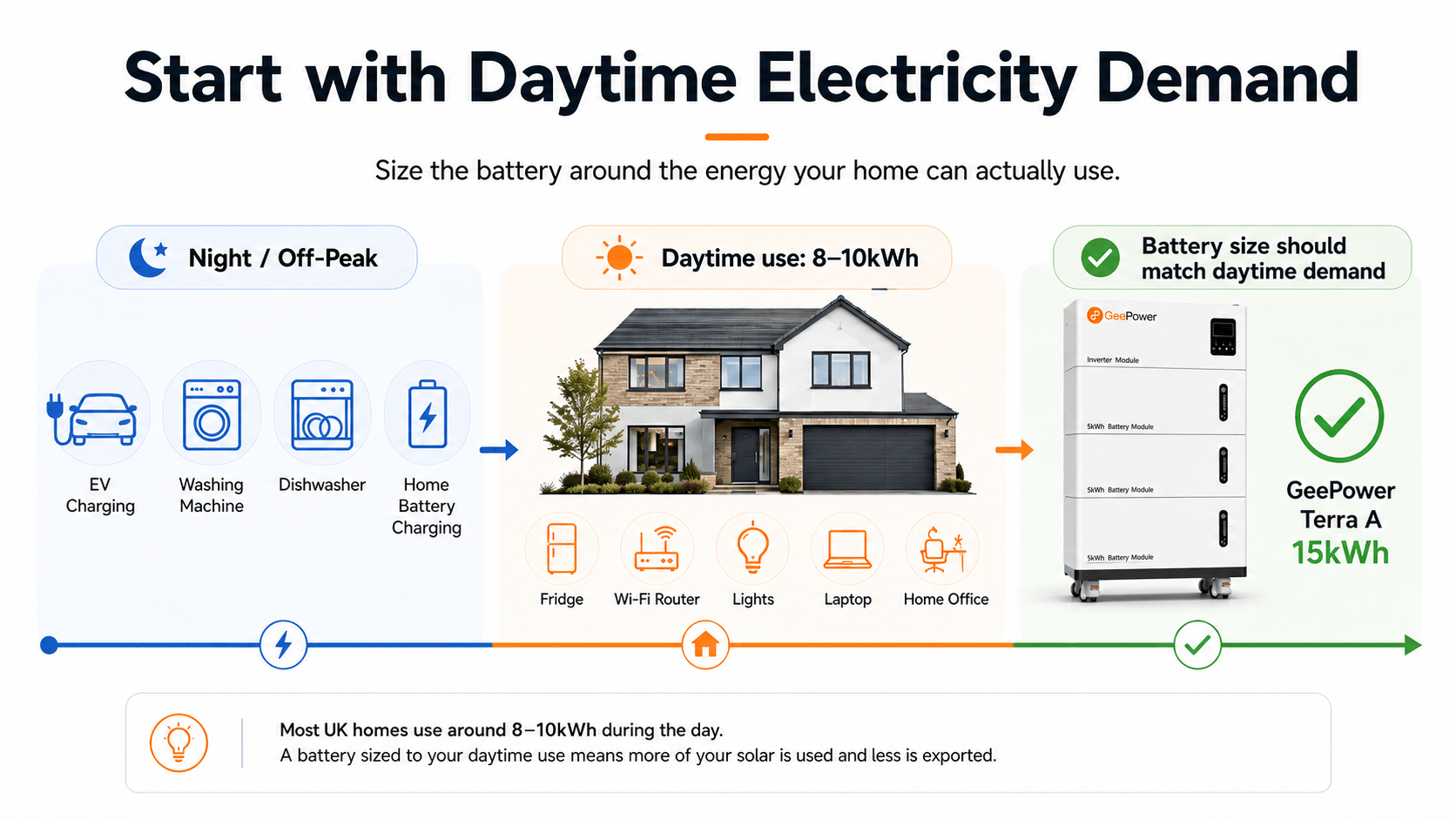
For example, if you use off-peak electricity to charge the battery overnight, the battery’s job is usually to cover your more expensive daytime electricity use.
A typical pattern might look like this:
· Night: EV charging, washing machine, dishwasher and battery charging
· Daytime: fridge, Wi-Fi, lighting, standby loads, home office, heat pump or other appliances
· Evening: cooking, entertainment, lighting and higher household activity
If your daytime electricity demand is around 8–10kWh, then a 10–15kWh battery may be a practical range to consider.
If your daytime demand is much higher, a larger battery may make sense.
If your daytime demand is low, installing a very large battery may not deliver much extra value.
The key point is simple:
Size the battery around the electricity you can actually use.
Step 2: Understand kWh and kW
When choosing a home battery, two numbers matter:
kWh tells you how much energy the battery can store.
kW tells you how much power the system can deliver at one time.
They are different.
A 15kWh battery does not mean the home can run unlimited appliances at the same time.
It means the battery can store up to 15kWh of energy.
The inverter output determines how much power can be supplied at once.
For example, if a home is using several appliances at the same time, the total demand may rise quickly.
Cooking, boiling a kettle, running a washing machine and using other household appliances can create short periods of higher load.
In this situation, a well-designed home battery system does not need to carry everything alone.
Terra A can supply the home from the battery, while the utility grid automatically provides additional power when required.
This is why battery sizing is not only about capacity.
It is also about understanding how the home uses power.
Step 3: Match Battery Size to Your Home Type
There is no single battery size that fits every UK home.
But the following examples can help homeowners understand the logic.
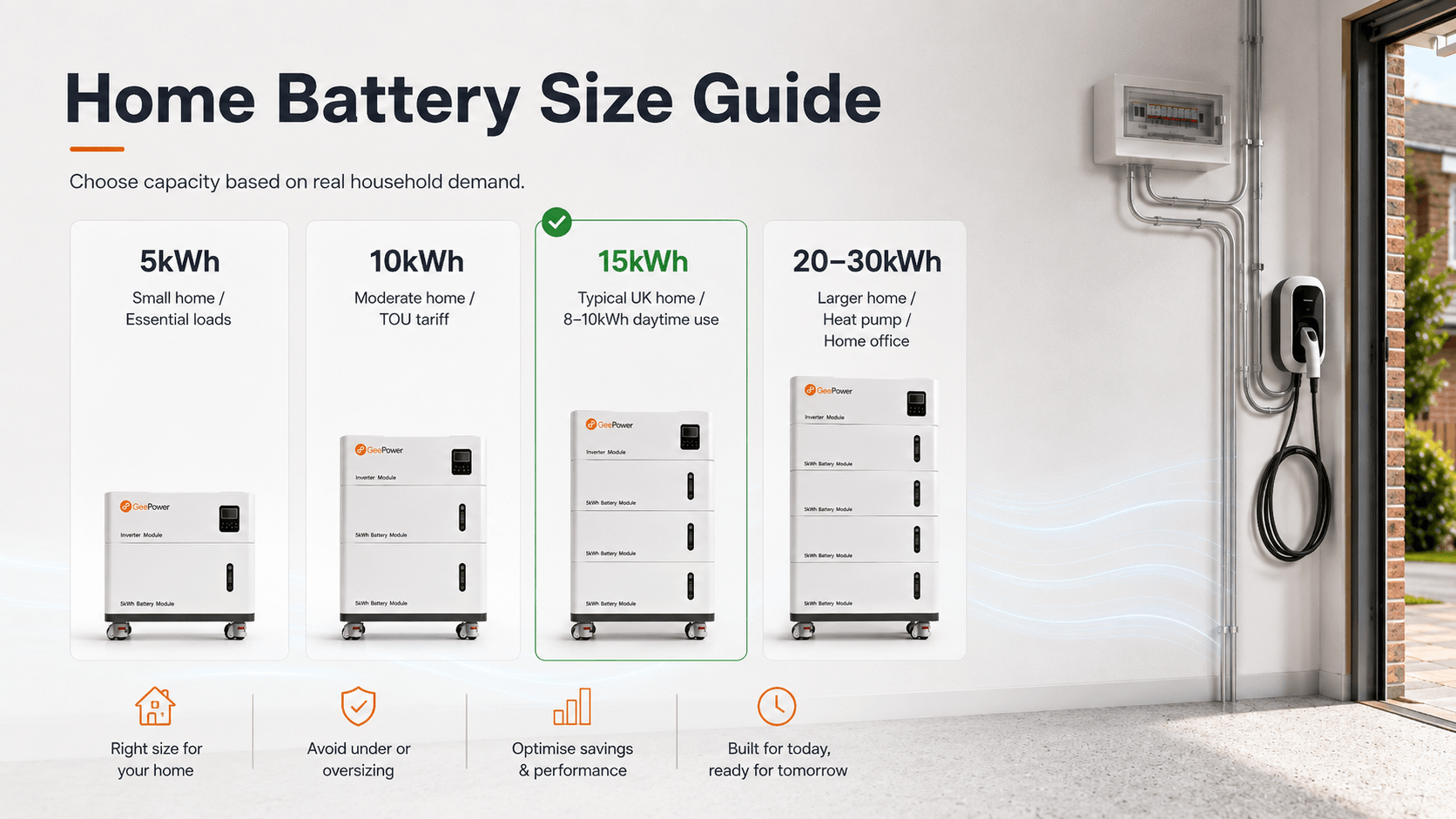
5kWh Battery
A 5kWh battery may be suitable for:
· Smaller homes
· Lower daytime electricity demand
· Basic solar self-consumption
· Essential backup loads
· Households testing battery storage for the first time
It can help reduce grid import, but it may not cover a full day of daytime electricity use for many households.
10kWh Battery
A 10kWh battery may be suitable for:
· Typical homes with moderate daytime electricity use
· Households using Time-of-Use tariffs
· Solar homes that want to store more daytime generation
· Families that want a practical balance between capacity and cost
For many homes, 10kWh can be a strong starting point.
15kWh Battery
A 15kWh battery may be suitable for:
· Homes with around 8–10kWh daytime electricity use
· Households using off-peak charging
· Homes with higher evening demand
· Families that want more energy flexibility
· Solar homes that want to store more excess generation
This is why 15kWh is often a practical size for many modern UK homes.
It provides more flexibility than smaller systems, without automatically moving into oversized capacity.
20–30kWh Battery
A larger 20–30kWh system may be suitable for:
· Larger homes
· Home offices
· Heat pumps
· Higher daytime consumption
· Larger families
· Homes planning future energy demand growth
· Customers who want more stored energy for selected backup loads
A larger battery only makes sense if the home can use the additional stored energy.
Otherwise, extra capacity may not improve savings.
Step 4: Consider Solar Generation
If your home has solar panels, battery sizing should also consider how much excess solar energy is available.
Without a battery, excess solar energy may be exported to the grid.
With a battery, more of that energy can be stored and used later.
But the battery still needs to match the solar system and the home’s energy use.
If the solar system is small, a very large battery may not charge fully from solar alone.
If the solar system is larger, or the home has strong daytime generation and evening demand, more battery capacity may be useful.
The goal is not simply to install the largest battery.
The goal is to store the energy that would otherwise be wasted or exported, and use it when the home needs it.
In a typical solar-plus-storage setup:
Solar powers the home first.
Excess solar charges the battery.
The battery supplies the home when solar is not enough.
The grid supports when both solar and battery are not enough.
Step 5: Consider Time-of-Use Tariffs
For households using Time-of-Use tariffs, battery sizing has another important factor:
How much low-cost electricity do you want to store overnight?
If the off-peak period allows the battery to charge at a lower electricity price, the battery can then supply the home during more expensive daytime or evening periods.
For this use case, the battery should be large enough to cover the amount of expensive grid electricity the home wants to replace.
For example:
If your home typically uses 8–10kWh during daytime hours, a 10–15kWh battery may be worth considering.
If your home uses much more than that during the day, a larger system may be useful.
If your daytime use is low, a smaller battery may already cover most of the demand.
This is why the right battery size depends on your tariff as well as your household energy use.
Step 6: Think About Future Energy Demand
A home’s electricity demand may change over time.
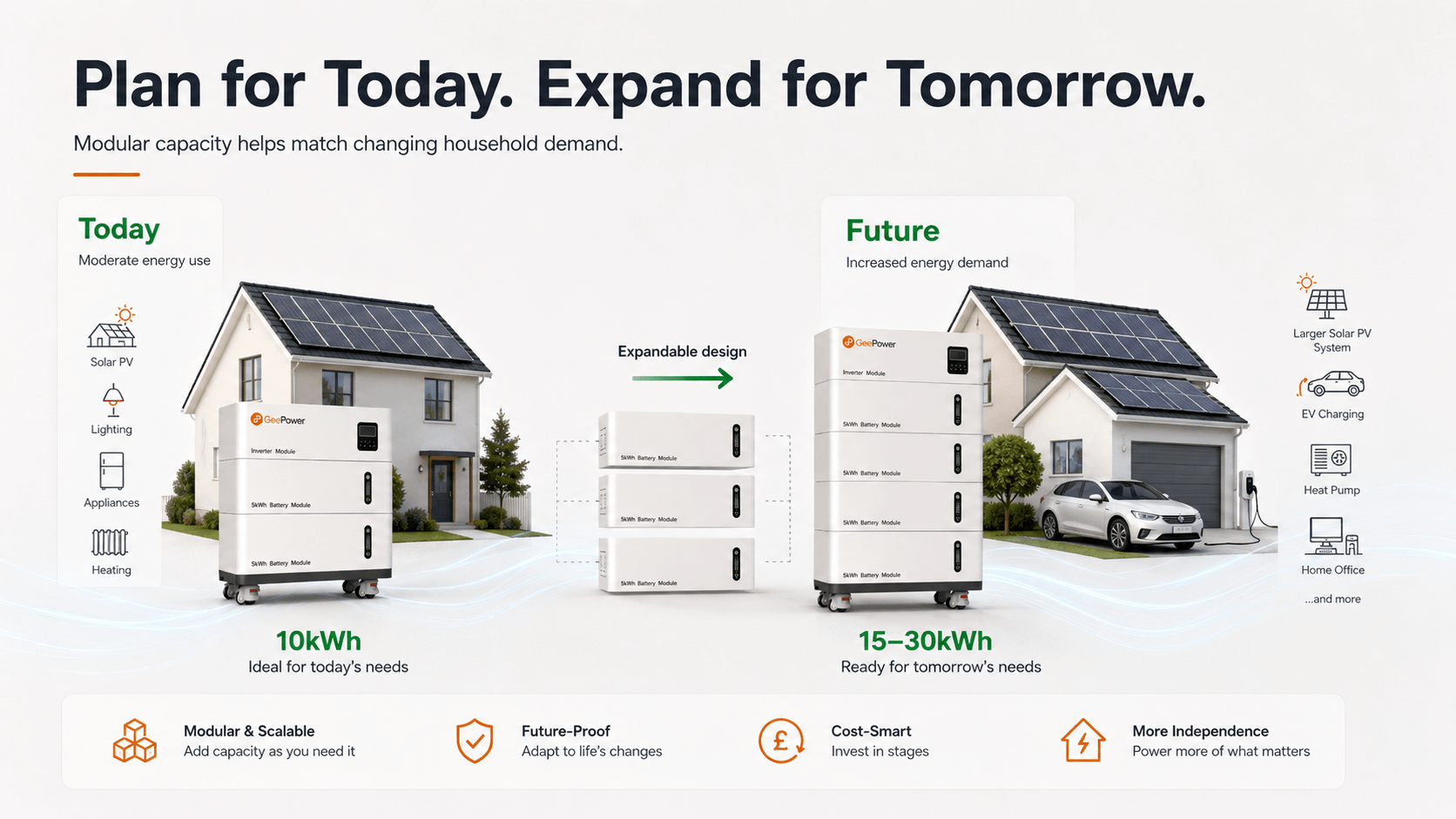
Today, you may only need a smaller battery.
But in the future, you may add:
· An electric vehicle
· A heat pump
· A home office
· More appliances
· A larger solar PV system
· Higher daytime energy use
This is where modular battery design becomes valuable.
Instead of choosing one fixed capacity forever, a modular system allows the battery capacity to grow with the home’s needs.
GeePower Terra A is designed with stackable battery modules, allowing capacity to be expanded from 5kWh to 30kWh depending on the required configuration.
For homeowners, this means more flexibility.
For installers and distributors, it means one product platform can support different household needs.
A Simple Home Battery Sizing Checklist
Before choosing a battery size, homeowners should ask six practical questions:
1. How much electricity does the home use during daytime hours?
2. Is the home using a Time-of-Use tariff?
3. Does the home have solar panels?
4. How much excess solar energy is available?
5. Are there high-demand appliances, a heat pump or an EV?
6. Does the homeowner want backup power for selected essential loads?
The answer to these questions will usually point toward a practical capacity range.
A small home may only need a smaller battery.
A typical home may benefit from 10–15kWh.
A larger or more electrified home may need 20–30kWh.
There is no universal answer.
There is only the right answer for the specific home.
Does a Bigger Battery Always Save More Money?
Not necessarily.
A larger battery only creates more value if the home can use the additional stored energy.
If the battery is regularly charged and discharged in a useful way, more capacity may help reduce expensive grid imports.
But if the battery often remains partly unused, the extra capacity may not improve the return.
That is why the best battery size should be based on:
· Real energy usage
· Tariff schedule
· Solar generation
· Future demand
· Backup expectations
· Installation budget
The goal is not maximum capacity.
The goal is maximum useful capacity.
What Size Battery Is Right for a Typical UK Home?
For many UK homes, a practical starting point is usually between 10kWh and 15kWh.
A 10kWh battery may suit homes with moderate daytime demand.
A 15kWh battery may offer more flexibility for households with higher daytime use, stronger evening demand or off-peak charging strategies.
Larger systems may be suitable for homes with heat pumps, home offices, larger families or higher electrification plans.
The most important point is this:
Battery sizing should follow the household’s energy profile, not just a product catalogue.
A Smarter Way to Choose a Home Battery
Choosing the right home battery size is not about guessing.
It is about understanding how the home uses electricity.
How much energy is needed during the day?
How much solar energy can be stored?
How much off-peak electricity should be shifted?
How much future demand should the system prepare for?
Once these questions are answered, battery sizing becomes much clearer.
For many UK homes, the right solution is not simply a bigger battery.
It is a smarter, properly matched battery system.
That is how GeePower Terra A is designed to support modern homes:
Flexible capacity.
Smart energy management.
Modular expansion.
Reliable everyday use.
GeePower provides modular residential energy storage solutions for installers, distributors, wholesalers and energy project partners.
Whether you are planning solar upgrades, off-peak tariff applications or residential battery storage projects, our team can help you choose the right configuration for your market.
Contact GeePower to request product details, datasheets and cooperation options.