
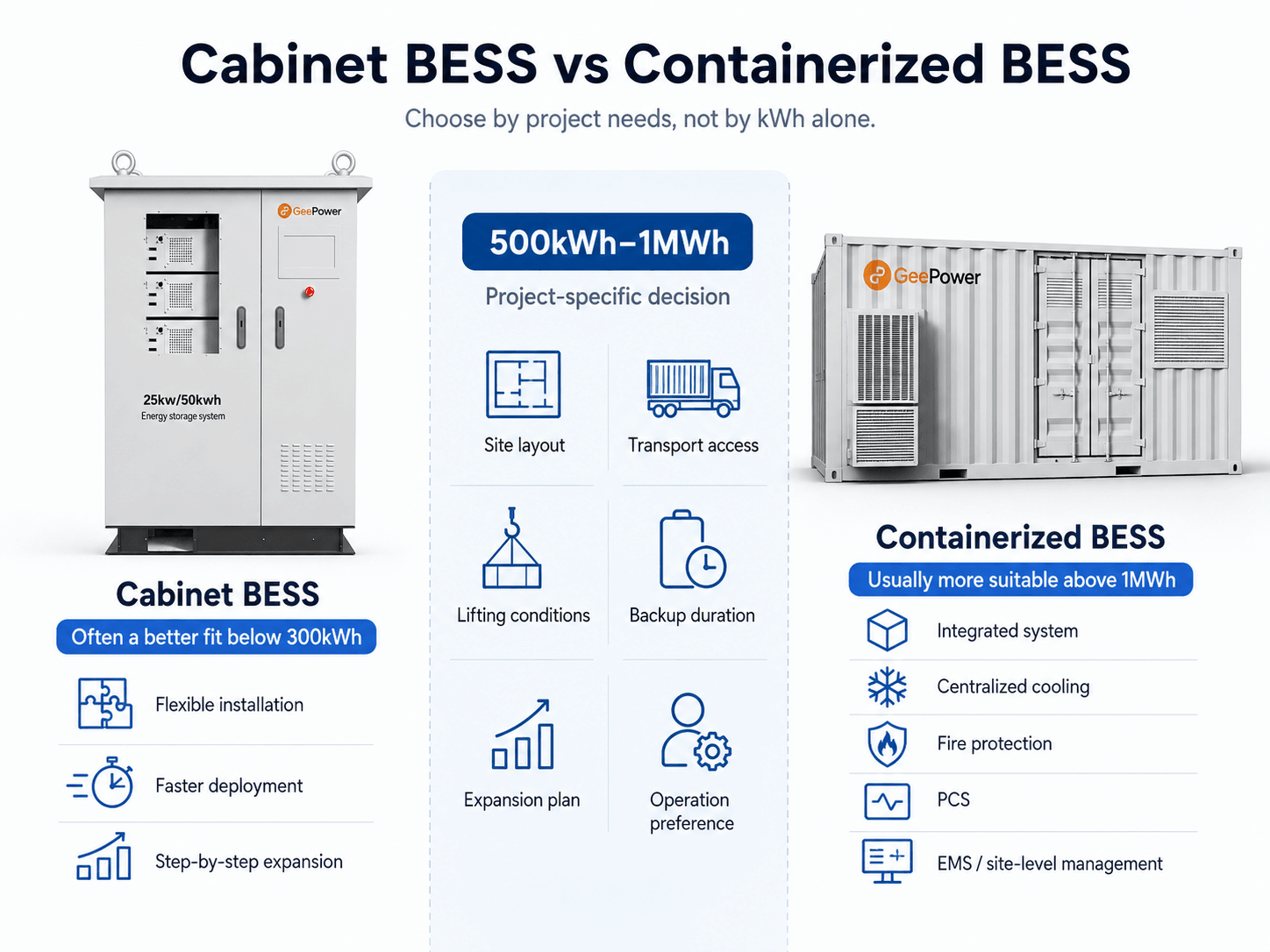
Choosing between a cabinet BESS and a containerized BESS for commercial and industrial energy storage system is not just about total battery capacity.
As a general rule, cabinet BESS is often a better fit for projects below 300kWh, especially when the customer needs flexible installation, faster deployment, and step-by-step expansion. Containerized BESS is usually more suitable above 1MWh, where the project needs a larger integrated system with centralized cooling, fire protection, PCS, EMS, and site-level energy management.
The middle range, roughly 500kWh to 1MWh, is where the decision becomes more project-specific. In that range, EPCs should not choose by kWh alone. Site layout, transport access, lifting conditions, backup duration, expansion plan, and the customer’s operation preference all matter.
What Is a Cabinet BESS?
A cabinet BESS is an outdoor battery energy storage system built inside one or more electrical cabinets.
A typical cabinet can integrate battery modules, BMS — battery management system, PCS — power conversion system, EMS — energy management system, power distribution, cooling, and fire protection.
In plain terms, it is a compact all-in-one energy storage unit.
GeePowerESS cabinet BESS models include:
Model |
System Type |
Rated Energy |
Rated Power |
Cooling |
Protection |
GP50-256V200Ah |
20kW / 51.2kWh |
51.2kWh |
20kW |
Intelligent air cooling |
IP54 |
GP107-716V150Ah |
50kW / 107kWh |
107.4kWh |
50kW |
Intelligent air cooling |
IP54 |
GP215-768V280Ah |
100kW / 215kWh |
215.04kWh |
100kW |
Intelligent air cooling |
IP54 |
These systems are usually suitable for smaller C&I projects, such as commercial buildings, workshops, farms, EV charging support, solar self-consumption, selected-load backup, and weak-grid sites.
The main advantage is flexibility. A cabinet system can start small and grow later. It can also be easier to place on sites where a container would be too large or difficult to install.
What Is a Containerized BESS?
A containerized BESS is a larger energy storage system built inside a container enclosure.
It is designed for bigger projects where the battery system, PCS, EMS, cooling, fire protection, monitoring, and power distribution need to work as one centralized system.
GeePowerESS containerized BESS models include:
Model |
Battery Energy |
Battery Clusters |
Rated Output Power |
Cooling |
Protection |
GP-ESS1000-716.8V1400Ah |
1003.52kWh |
5 clusters |
500kW |
Air conditioner |
Outdoor IP54 |
GP-ESS1500-768V1960Ah |
1505.28kWh |
7 clusters |
500kW |
Air conditioner |
Outdoor IP54 |
GP-ESS5000-716.8V700Ah |
5017.6kWh |
25 clusters |
500kW |
Air conditioner |
Outdoor IP54 |
A containerized BESS is usually used for large factories, industrial parks, microgrids, solar farms, utility projects, or site-level energy management.
Compared with cabinets, containerized systems require more planning. They need outdoor space, transport access, lifting access, foundation preparation, and a clearer long-term capacity plan. But for MWh-scale projects, that larger integrated structure is often exactly what makes the system easier to manage.
Cabinet BESS vs Container BESS: Quick Comparison
Factor |
Cabinet BESS |
Containerized BESS |
Typical project size |
Below 300kWh, or modular expansion |
Above 1MWh |
GeePowerESS examples |
51.2kWh, 107.4kWh, 215.04kWh |
1003.52kWh, 1505.28kWh, 5017.6kWh |
Power range |
20kW, 50kW, 100kW |
500kW rated output |
Installation |
Flexible, modular, easier to place |
Centralized outdoor deployment |
Expansion |
Add cabinets step by step |
Add container blocks |
Cooling |
Intelligent air cooling |
Air conditioner / system-level cooling |
Fire protection |
PACK aerosol / cabinet aerosol |
Integrated container-level fire protection |
Best fit |
Small and mid-sized C&I projects |
Large C&I, microgrid, solar farm, utility-scale projects |
Main risk |
Too many cabinets increase complexity |
Oversized for small projects |
When Cabinet BESS Is the Better Choice
Cabinet BESS is usually the better choice when the project needs flexibility.
This often includes projects where capacity starts below 300kWh, or where the customer wants to expand gradually instead of buying one large system from the beginning.
Cabinet BESS is especially suitable when:
● the site has limited space;
● the customer wants lower initial investment;
● the project may expand in phases;
● transport or lifting access is limited;
● selected loads need backup power;
● solar self-consumption or peak shaving is the main goal;
● maintenance teams prefer smaller serviceable units.
A 100kW / 215kWh cabinet, for example, can be a practical starting point for a factory, farm, workshop, or commercial building. It is large enough for real C&I applications, but still much easier to deploy than a full containerized system
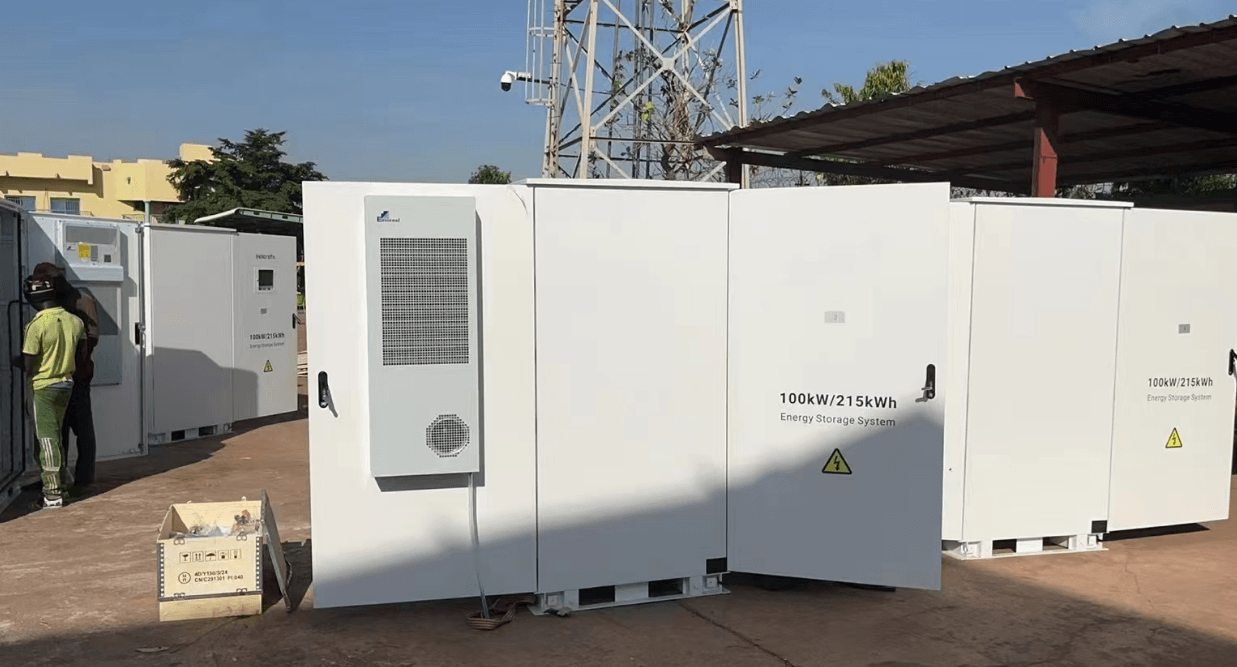
Mali Bamako 1MWh integrated project: an off-grid factory project combining solar PV, battery storage, and diesel generators. The project used 860 pieces of 580Wp solar modules and five 215kWh energy storage cabinets.
This Mali project shows an important point: cabinet systems can be combined for larger projects. Five 215kWh cabinets can create a 1MWh-level storage setup. That does not mean cabinets are always better at this scale, but it proves that cabinet-based architecture can work when the site needs distributed installation or flexible project design.
When Cabinet BESS Is Not the Best Choice
Cabinet BESS becomes less attractive when the project needs a very large single system.
It may not be the best choice when:
● the required capacity is above 1MWh and the customer wants one integrated unit;
● too many cabinets would be needed;
● the project requires MW-level power output;
● centralized cooling and fire protection are preferred;
● the customer wants fewer devices to inspect and maintain;
● cable routing and communication between cabinets becomes too complex.
This is where many projects shift toward containerized BESS.
Multiple cabinets can reach MWh-level capacity, but too many cabinets can create new problems. More cabinets mean more wiring, more communication points, more maintenance points, and more site coordination. At some point, a container may be easier to manage.
That point is not the same for every project. But once the system moves beyond several cabinets, EPCs should compare the total system architecture, not only the total kWh.
When Containerized BESS Is the Better Choice
Containerized BESS is usually the better fit when the project moves into MWh-scale energy storage.
It is especially suitable when:
● the required capacity is above 1MWh;
● the project needs centralized energy management;
● the site has outdoor space;
● transport and lifting access are available;
● the customer prefers one integrated system;
● the project is a solar farm, factory, microgrid, industrial park, or utility-scale application.
GeePowerESS containerized systems start from around 1MWh and go up to more than 5MWh. These systems use multiple battery clusters and 500kW rated output power, making them better suited for large C&I loads and site-level applications.
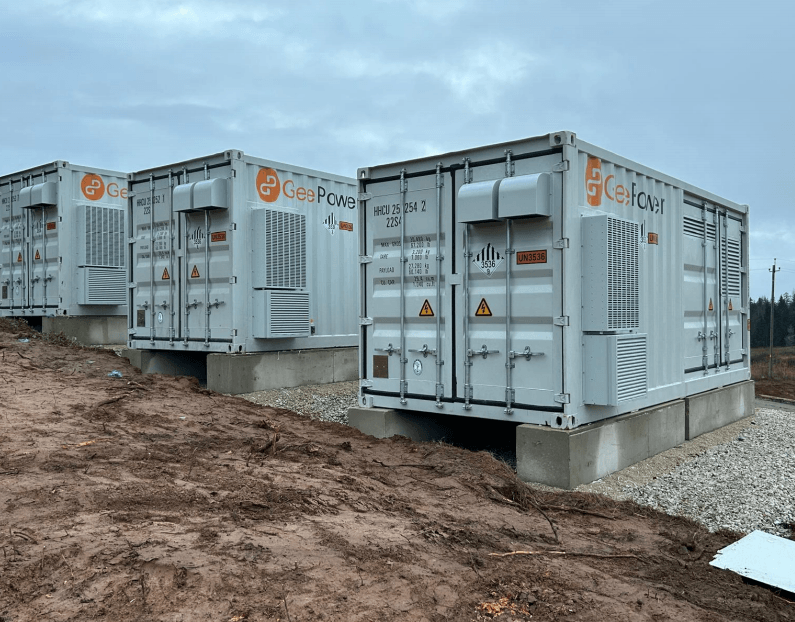
Europe, Estonia 3MWh integrated project: 2MW solar PV + 3MWh battery storage using three 1000kWh containerized ESS units and three 500kW hybrid inverter systems.
The Estonia project is a good example. The system combines 2MW solar PV with 3MWh of storage for a heat pump factory. Its operating mode is PV + BESS + grid. The goal is to increase solar self-consumption, reduce operating costs, and generate revenue through export when conditions allow.
For this kind of outdoor, MWh-scale project, containerized BESS is usually more practical than placing many separate cabinets across the site.
When Containerized BESS Is Not the Best Choice
A containerized BESS is powerful, but it is not always the right answer.
It may be a poor fit when:
● the project only needs below 300kWh;
● the site is indoors, on a rooftop, or in a tight space;
● roads are too narrow for container transport;
● crane lifting is difficult or expensive;
● the customer wants to expand in small steps;
● the initial budget is limited;
● the application only supports selected loads.
In those cases, a container may create more cost and complexity than value.
This is a common mistake. Some customers see containerized BESS as “more professional” because it looks larger and more complete. But if the project does not need MWh-scale storage, the bigger system may simply be oversized.
A good system is not the largest system. It is the system that fits the load, site, budget, and expansion plan.
The 500kWh–1MWh Gray Zone
The most difficult decision is often between 500kWh and 1MWh.
This is the gray zone.
A project in this range could use multiple cabinets. It could also use a smaller containerized solution, depending on the supplier design and site requirements.
Here is how EPCs can think about it:
Decision Factor |
Cabinet BESS May Fit Better |
Containerized BESS May Fit Better |
Customer preference |
Accepts multiple units |
Wants one integrated unit |
Site layout |
Space is limited or distributed |
One clear outdoor area is available |
Transport access |
Forklift or smaller equipment is easier |
Container transport and crane lifting are possible |
Expansion plan |
Wants phased expansion |
Has a clear MWh-scale plan |
Operation |
Can manage several cabinets |
Wants centralized management |
System complexity |
Modular design is acceptable |
Simpler single-block architecture is preferred |
For example, if a factory needs around 600kWh and has several load points, multiple cabinets may make sense. If the same factory wants a single outdoor system with simpler centralized management, a containerized BESS may be easier to operate.
There is no universal answer. The better choice depends on the project.
Key Selection Factors EPCs Should Check
1. Required Energy Capacity
Energy capacity is measured in kWh or MWh. It tells you how much energy the battery can store.
Cabinet systems are practical building blocks at 51.2kWh, 107.4kWh, and 215.04kWh. Container systems are designed for larger capacities, such as 1003.52kWh, 1505.28kWh, and 5017.6kWh.
2. Required Power Output
Power output is measured in kW. It tells you how much load the system can support at one time.
This matters because a project can have enough battery capacity but still fail if the power output is too low. A 215kWh cabinet with 100kW output and a 1MWh container with 500kW output are not designed for the same load profile.
3. Load Profile
A load profile shows how the site uses electricity during the day.
For peak shaving, look at peak demand. For backup power, look at critical loads and backup duration. For solar self-consumption, compare solar generation time with site consumption time.
4. Site Access
Cabinet systems are easier when the site has limited access.
Containerized systems need more space. They also need transport routes, lifting access, and foundation planning. If the site cannot support these conditions, cabinet BESS may be the safer choice.
5. Expansion Plan
If the customer wants to start small and grow later, cabinets are often more flexible.
If the project already has a clear MWh-scale target, a containerized system may be easier to standardize from the start.
Common Mistakes When Choosing Between Cabinet and Container BESS
Mistake 1: Choosing Only by kWh
A 500kWh project does not automatically mean cabinet or container. EPCs must also check kW, site space, load profile, backup duration, and expansion plan.
Mistake 2: Ignoring PCS Power
PCS means power conversion system. It controls how much power the battery system can deliver or absorb.
If the PCS power is too low, the system may not support the required loads even if the battery capacity looks large enough.
Mistake 3: Using Too Many Cabinets Without Planning
Multiple cabinets can work well. But too many cabinets may increase cable routing, communication design, protection coordination, and maintenance work.
Mistake 4: Choosing a Container Too Early
A containerized system may be oversized for a small commercial site. Below 300kWh, cabinet BESS is usually more practical and cost-efficient.
Mistake 5: Ignoring Transport and Lifting Conditions
A containerized BESS needs proper transport and lifting access. If the site roads, foundation, or crane conditions are not ready, installation can become difficult and expensive.
What EPCs Should Prepare Before Asking for a Recommendation
Before asking a supplier whether cabinet BESS or containerized BESS is better, prepare these details:
Information |
Why It Matters |
Project location |
Affects temperature, grid condition, and installation environment |
Application |
Peak shaving, backup power, solar self-consumption, EV charging, microgrid, or off-grid |
Required capacity |
Helps define the kWh or MWh range |
Required power output |
Helps define PCS power |
Load profile |
Shows peak demand and daily power use |
Backup loads |
Shows what must keep running during outage |
Backup duration |
Determines usable energy requirement |
Installation site |
Indoor, outdoor, rooftop, ground-mounted, or container yard |
Transport and lifting access |
Critical for container projects |
Expansion plan |
Helps decide modular cabinet or centralized container |
Grid condition |
Important for weak-grid and off-grid projects |
The more complete this information is, the better the recommendation will be.
GeePower ESS C&I BESS Options
GeePowerESS provides both cabinet and containerized BESS for C&I projects.
Cabinet options include 20kW / 51.2kWh, 50kW / 107.4kWh, and 100kW / 215.04kWh outdoor integrated systems. They are suitable for small and mid-sized commercial projects, solar self-consumption, EV charging support, selected-load backup, farms, workshops, and weak-grid site Cabinet BESS ? See more
Containerized options include 1003.52kWh, 1505.28kWh, and 5017.6kWh systems with 500kW rated output. They are suitable for large factories, industrial parks, microgrids, solar farms, and MWh-scale site energy management.
Container BESS? See more
Need help choosing between cabinet BESS and containerized BESS?
Send GeePowerESS your project size, load profile, backup requirement, site conditions, and expansion plan. Our team can help recommend a suitable C&I battery energy storage architecture for your project.
FAQ
Yes, it can be. A 500kWh project can use multiple cabinets if the site layout supports distributed installation. But if the customer wants one integrated unit or plans to expand toward MWh scale, containerized BESS may be more practical.
As a practical rule, containerized BESS becomes more suitable above 1MWh. Below 300kWh, cabinet BESS is usually more practical. Between 500kWh and 1MWh, the decision should be based on site layout, customer preference, expansion plan, and system complexity.
Sometimes yes. Multiple cabinets can build a larger system, especially for distributed or phased projects. But too many cabinets can increase wiring, communication, and maintenance complexity.
No. Containerized BESS is better for larger, centralized, outdoor, MWh-scale projects. Smaller industrial sites may be better served by cabinet systems.
Send the project location, required capacity, power demand, load profile, backup duration, application type, installation environment, grid condition, transport access, and expansion plan.