Terra A in the UK
The story of GeePower, Matt Stockdale and a home-energy system shaped around real UK households.
The Home Battery That Started with an Idea We Were Not Sure We Believed
“At Cost?” Our First Reaction Was: Can That Really Work?
The story began in November 2024.
That was when GeePower first started speaking with Matt Stockdale about the UK residential energy-storage market.
From the beginning, Matt was very clear about his idea: he wanted to make home-battery systems available to ordinary households at cost—an ambition that would later take shape through The 22:23 Community Interest Company.
No large retail mark-up. No attempt to turn every installation into a high-margin sale. Just a model that covered the essential costs while making good-quality home-energy storage accessible to more ordinary UK households.
Our honest reaction?
It sounded almost too idealistic.
The residential energy-storage industry already had well-established commercial models, and premium pricing was common. Developing, testing, certifying, importing and supporting a product for a new market also required substantial investment.
So, at first, we were not completely convinced that such a model could work in practice.
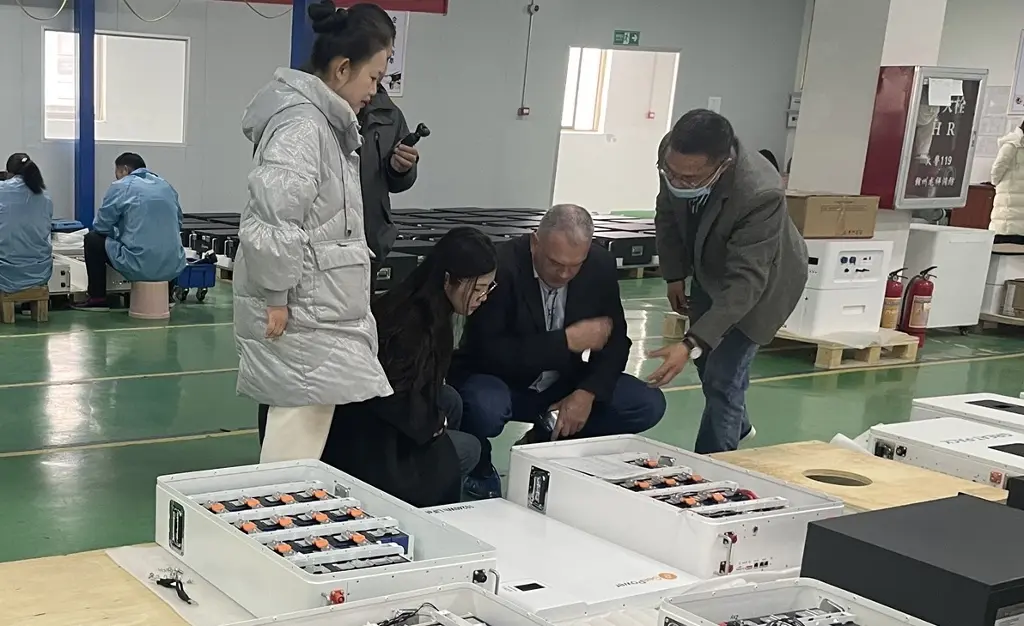
Even when Matt travelled to China and visited the GeePower factory on 16 February 2025, we still treated the meeting as a relatively conventional overseas customer visit.
We hoped it would lead to a stable business partnership.
What we did not yet understand was that Matt was not simply looking for another battery to sell.
It took many months—and several important decisions—for us to understand what he was really trying to build.
One Factory Visit, Several Products—and One Clear Choice
During his visit, Matt examined several of GeePower’s stackable residential energy-storage systems.
He eventually chose Terra A Series.
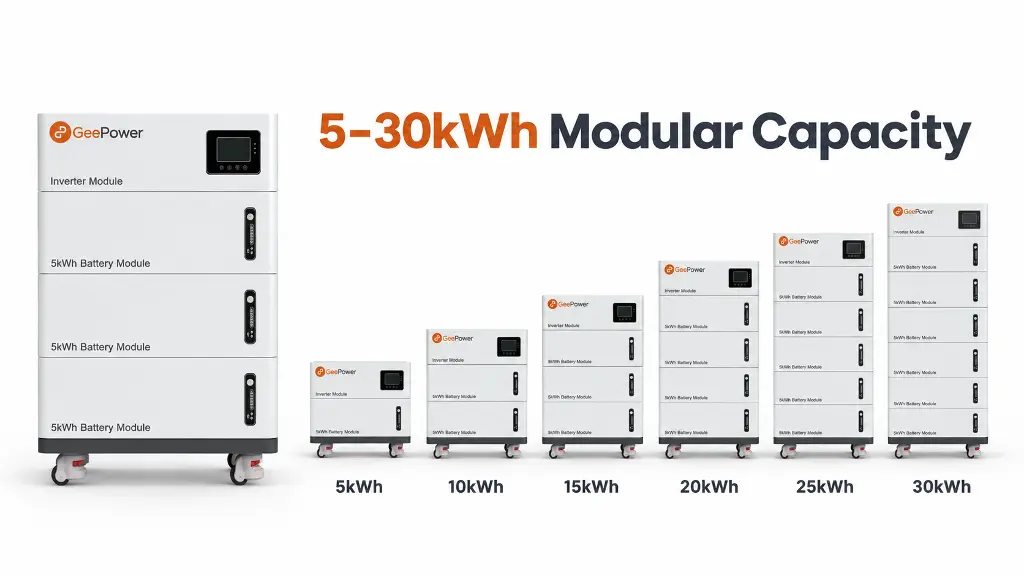
The reason was straightforward: it was modular, flexible and easy to adapt to different households.
Terra A can be configured from 5kWh to 30kWh. A smaller household can begin with fewer battery modules, while a larger home or a family with higher electricity consumption can choose a higher-capacity configuration.
That flexibility mattered in the UK.
British homes are far from identical. They vary in size, age, available installation space, wiring, heating systems, electric-vehicle use and daily energy consumption.
A single fixed-capacity product would never suit everyone.
But the longer we worked with Matt, the clearer another difference became.
Like many customers, he asked a lot of questions. He paid attention to small details. He challenged product decisions and wanted to understand why each component was necessary.
However, his questions were not about how to make the product look more premium or how to create a higher retail margin.
They nearly always came back to the same point:
Does the household really need this—and is it worth what they will have to pay for it?
Every Feature Had to Earn Its Place
Residential energy-storage products can be designed with increasingly sophisticated specifications: high-voltage platforms, higher protection ratings, advanced interfaces and highly detailed monitoring applications.
These features can be useful in the right situation.
But Matt did not want to add a feature simply because it looked impressive in a brochure.
His approach was simple:
If a feature added cost, it had to provide a clear and practical benefit to the household.
The UK Terra A system still needed the functions that genuinely mattered—scheduled charging and discharging, reliable battery protection, stable everyday operation and backup support for selected critical loads when correctly configured.
But the aim was not to create the most complicated home battery on the market.
The aim was to create one that ordinary people could understand, use and reasonably afford.
That was when we began to realise that Matt’s focus was not “cheap at any cost”.
It was practicality without unnecessary cost.
There Was Just One Problem: Terra A Was Not Yet Ready for Britain
Choosing the product was the easy part.
Turning it into a system suitable for the UK was much harder.
At that time, GeePower’s existing stackable system had CE compliance, but it had not yet completed the UKCA and G99 work required for the UK market.
The original inverter configuration also did not include integrated timed charging and discharging. An additional timing device would have been needed to create the required operating schedule.
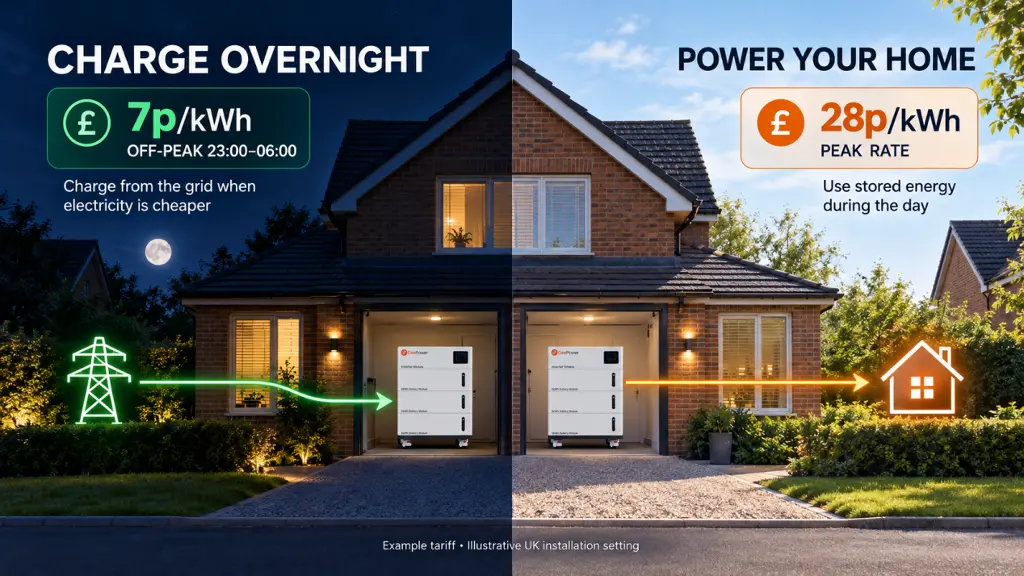
That mattered because Matt had introduced us to one of the most important characteristics of the UK energy market: the considerable difference between overnight and daytime electricity prices.
Some households—particularly those with electric vehicles—can access much cheaper electricity overnight. During the day, and especially during peak periods, the price can be significantly higher.
For households on flexible tariffs, the difference can be even greater.
Suddenly, the purpose of the UK Terra A became very clear:
Charge the battery when electricity is cheaper. Use that energy when grid electricity is more expensive.
After several rounds of internal discussion and assessment, GeePower decided to develop a dedicated Terra A configuration for Matt and the UK market.
Timed charging and discharging were integrated into the system. Dual MPPT inputs were also included so that Terra A could support households with solar PV while remaining useful for homes without rooftop solar.
That last point was important.
Matt did not want home batteries to be available only to households that could also afford a complete solar installation.
With Terra A, a suitable household could still store lower-cost overnight electricity and use it during the day—even without solar panels.
When Even an RCBO Can Start a Long Conversation
Developing the UK version was not simply a matter of changing a few inverter settings.
The project brought together two very different types of experience.
GeePower’s engineering team had worked on residential, commercial, off-grid and hybrid energy-storage systems across several international markets. The team wanted to retain mature and proven solutions wherever possible, helping to protect product stability and control the risks and costs of customisation.
Matt kept bringing the discussion back to the UK.
British residential wiring, G99 requirements, DNO procedures, installer expectations and local electrical practices could not simply be treated in the same way as another market.
The product had to work in real British homes—not just on a factory test bench.
That difference in perspective appeared everywhere.
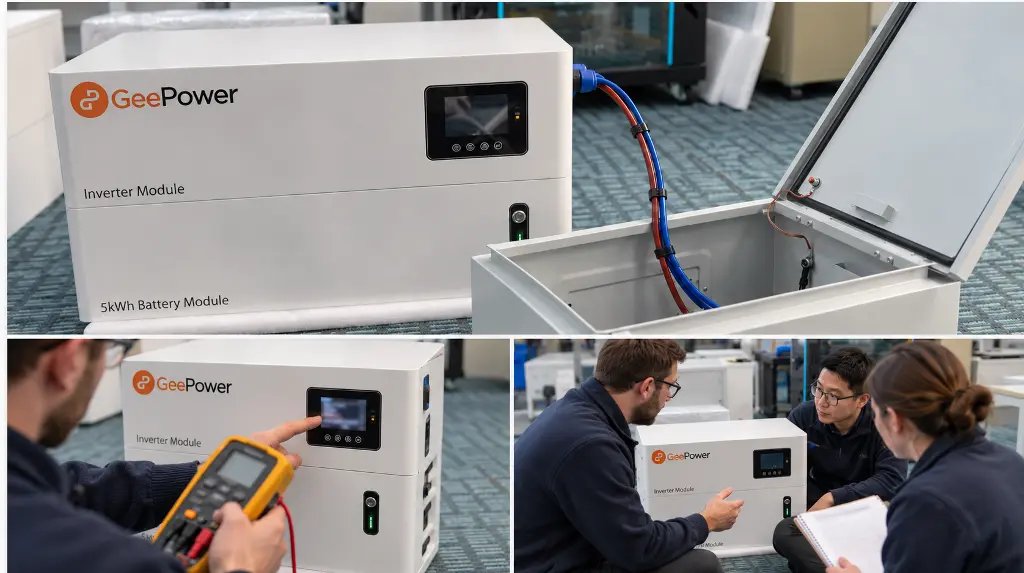
The teams discussed smart meters, RCBO ratings, rotary isolators, backup circuits, maintenance bypass arrangements and installer documentation.
Some of these components were physically small.
The conversations around them were not.
At certain points, the project moved more slowly than either side wanted. There were moments when both teams approached the same problem from completely different directions.
But neither side walked away.
GeePower continued reviewing the UK requirements and adapting the system. Matt continued explaining the reality of local homes, installers and DNO procedures.
Gradually, the two positions came together.
GeePower needed a solution that could be manufactured consistently, tested properly and supported over the long term.
Matt needed a system that was safe, compliant and genuinely suitable for UK households.
Once both sides fully understood that they were protecting different parts of the same project, progress became much easier.
The teams continued refining the system circuitry, protection configuration, grid-connection logic, operating functions and installation guidance.
The result was no longer a standard overseas product intended for general use.
It had become a Terra A configuration developed around a clearly defined UK residential application.
Then Came the Decision That Changed How We Saw Matt
One discussion became the turning point in the relationship.
It concerned long-term warranty support.
Supporting a home-battery system across two countries is very different from selling a product locally. Equipment installed in the UK cannot simply be returned to China every time something needs attention.
Fault diagnosis, replacement procedures and local after-sales support therefore had to be considered before the product entered the market.
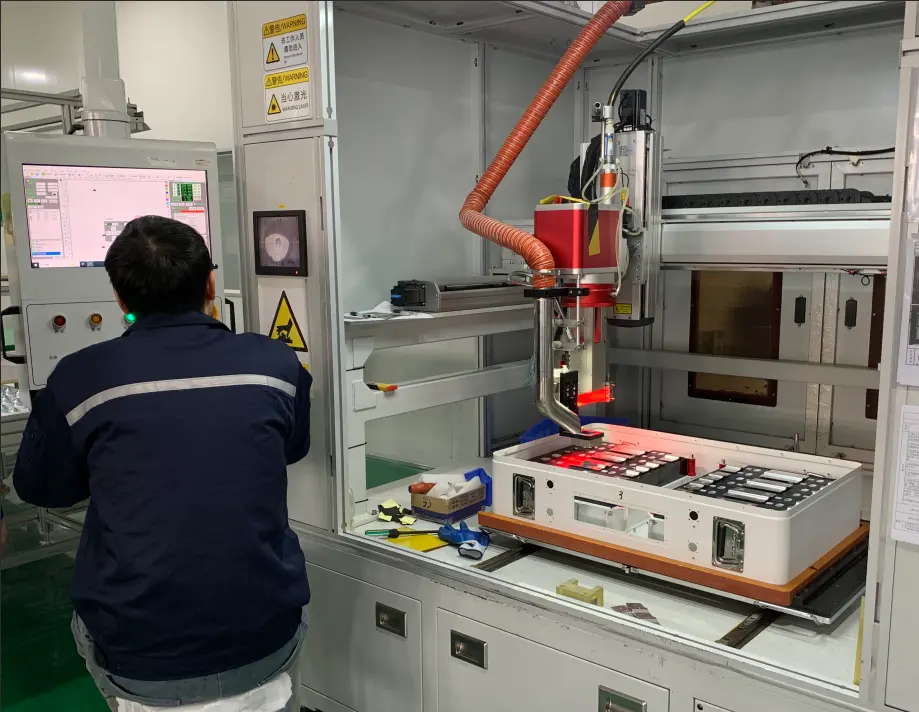
The inverter allowed key components to be inspected and replaced relatively easily. Terra A battery modules, however, use a highly integrated laser-welded structure.
For safety and consistency, if a battery module developed a confirmed fault, the normal solution would be to replace the module locally rather than dismantle it and repair individual cells in the UK.
To support the required long-term battery-performance commitment and reduce the possibility of future failures, GeePower proposed strengthening the specification of key battery components.
There was an obvious consequence.
The product cost increased.
Considerably.
We expected this to create another difficult negotiation. After all, Matt’s entire project was built around keeping the final price accessible.
Instead, he confirmed the additional cost, understood why the change was necessary—and supported the stronger specification.
No attempt to remove the upgrade.
No demand to reduce the quality to recover the original price.
That was the moment we fully understood his logic.
Matt was willing to remove features that increased the price without delivering meaningful value.
But when additional investment directly protected safety, reliability and long-term performance, he was prepared to accept it.
He was not trying to create the cheapest battery possible.
He was trying to create a dependable home-energy system at a fair and transparent price.
That decision removed many of the remaining doubts between the two teams. From that point, the development, testing and compliance work became a partnership built on much stronger trust.
Affordable does not mean compromised.
Behind a Few Compliance Logos Was Almost a Year of Work
From product development and inverter configuration to repeated testing and technical documentation, the UK Terra A project took almost a year.
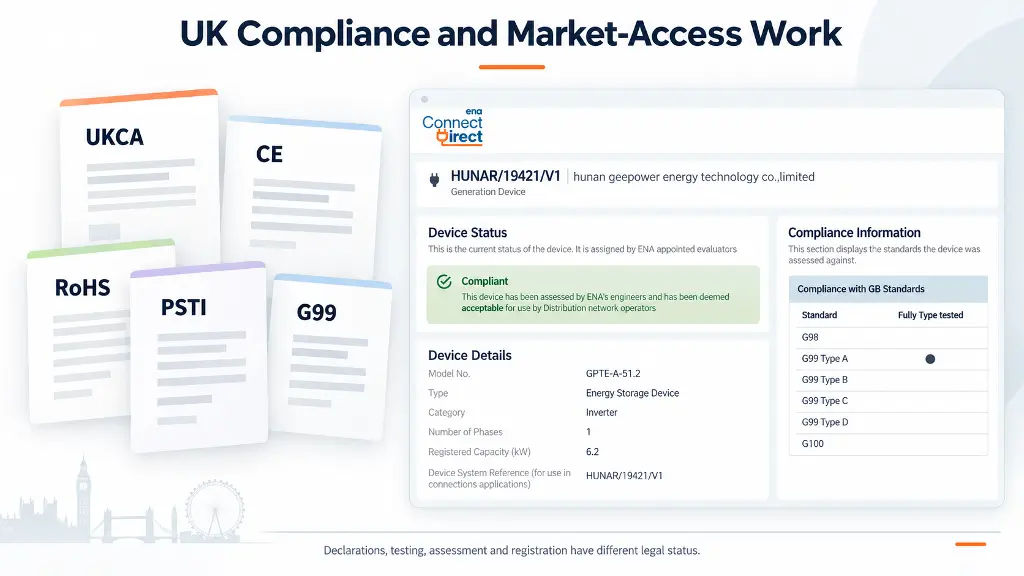
By February 2026, Terra A had progressed through the relevant UK market conformity assessment, testing and documentation work, including CE and UKCA requirements, RoHS and PSTI compliance, and G99 testing.
In March 2026, the first UK Terra A configuration was registered with the ENA under reference:
HUNAR/19421/V1
Those letters, numbers and compliance marks can look like a small part of a product page.
For the teams behind them, they represented months of communication, testing, engineering investment, revision and responsibility.
They also showed that GeePower was treating the UK project as a long-term commitment—not as a single shipment.
Standards and technical requirements continue to develop, so GeePower will continue updating the necessary test data, documentation and submissions for future Terra A configurations.
Every individual installation must also be assessed by a qualified professional. The final design, grid connection, export settings, backup configuration and installation method must comply with the current electrical regulations, DNO requirements and GeePower guidance applicable at the time.
Eventually, the Factory Had to Leave the Factory
During the development process, Matt repeatedly invited the GeePower team to visit the UK.
His argument was persuasive:
Drawings could show us the wiring.
Specifications could show us the electrical limits.
Video calls could show us the installation area.
But none of them could fully show us how British households actually lived.
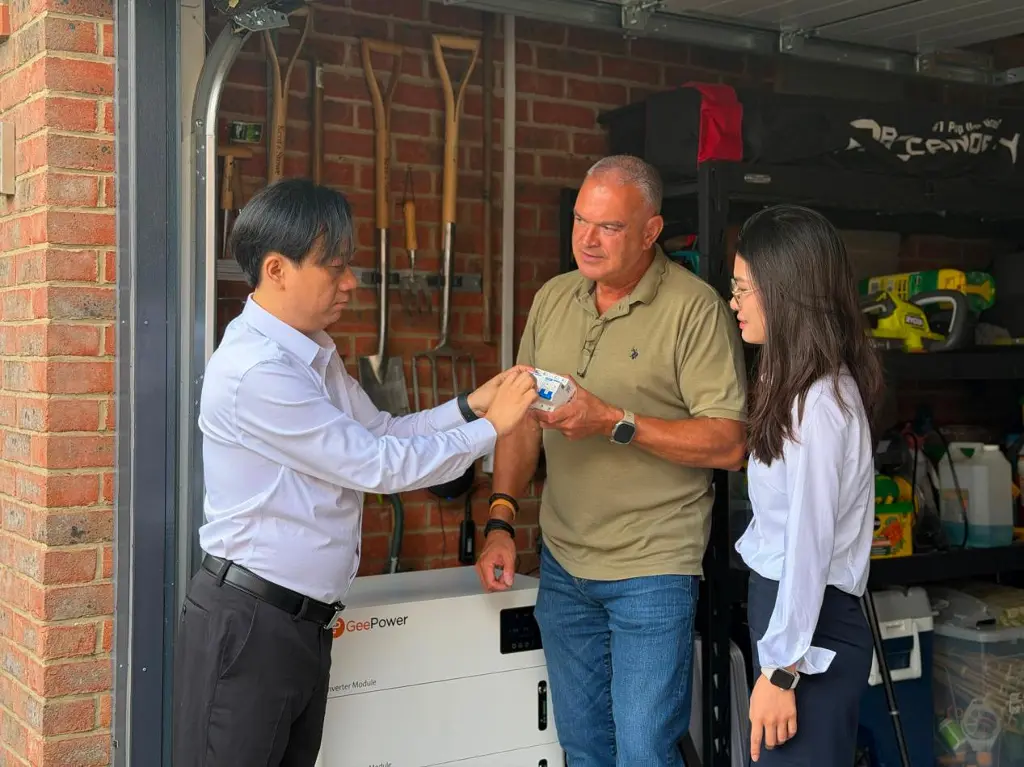
In August 2026, GeePower’s CTO and team travelled to Northampton.
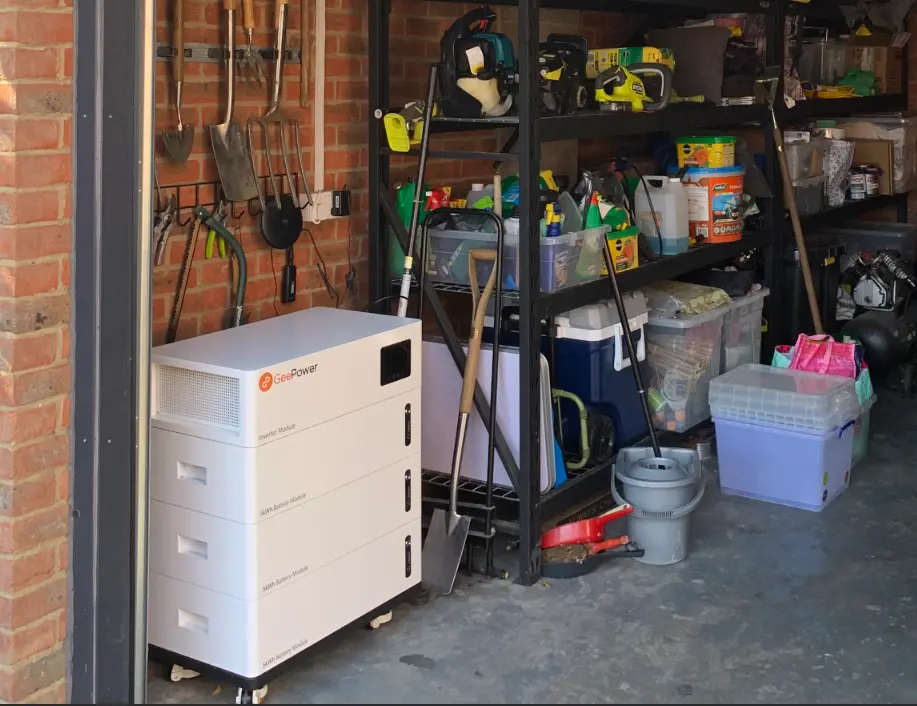
Matt accompanied the team through different residential areas and introduced us to different types of British homes. We looked at older properties, newer developments, garages and other potential installation spaces.
He explained the limitations of existing wiring, the questions installers would ask and the practical concerns of homeowners.
For the GeePower team, the visit changed the perspective.
A British home was no longer a diagram in a technical document. It was a real building, with limited space, existing cables, family routines and an electricity bill arriving every month.
The visit reinforced one of the most important lessons of the entire project:
A product designed for the UK must begin with the reality of UK homes—not only with the assumptions of a factory.
Matt’s patience and commitment during the visit also left a strong impression on the team. He continued explaining why he believed practical home-energy storage should be available to ordinary households and why he had continued pursuing the project for so long.
“Affordable should never mean compromised. The goal was simple: to make reliable home energy storage accessible to ordinary families.”
By the end of the visit, the relationship had moved far beyond a conventional conversation between a buyer and a manufacturer.
It had become a partnership built through repeated action, shared responsibility and trust.
“I trust you.” — GeePower CTO
The Promise Was Never “The Price Will Never Change”
The UK visit made something else clear.
A home-energy system has to be designed around the way people actually live—not only around what looks good on a specification sheet.
GeePower also made a long-term commitment to the cooperation.
Battery-cell prices change. Electronic-component costs change. Exchange rates and manufacturing costs change.
It would therefore be unrealistic to promise that the Terra A price will remain exactly the same forever.
The commitment is different:
GeePower will continue working with Matt to keep Terra A practical and competitively priced, while protecting the safety, quality and long-term reliability that households depend on.
The shared objective is not simply to sell more batteries.
It is to help more households take greater control of their electricity costs through a system designed for real, long-term use.
This Is More Than a Product Launch
The introduction of Terra A in the UK is not the story of a manufacturer finding a new customer.
It is the story of nearly two years of conversations, different opinions, technical challenges, repeated testing, patience and gradually earned trust.
Matt brought his understanding of UK households, his commitment to the at-cost approach and his insistence that affordability should never come at the expense of safety.
GeePower brought battery-manufacturing experience, engineering capability, investment in UK compliance and long-term technical support.
Together, we developed a system with a simple purpose:
To store electricity when it is cheaper and use it when grid electricity is more expensive.
To make home-energy storage useful with or without rooftop solar.
And to offer UK households a practical, reliable and compliant system at a fairer and more transparent cost.
Terra A is engineered and manufactured by GeePower.
But the UK version has also been shaped by Matt’s local knowledge, installer feedback and the reality of British homes.
The project began with an idea we were not sure we believed.
Nearly two years later, that idea has become a real product, in real UK homes, supported by a partnership that both sides worked hard to build.
Reliable technology. Fair access. Real homes.
Terra A in the UK?
For current UK pricing, ordering details and household enquiries, Terra A is available through The 22:23.